Skip over navigation
Cambridge University Faculty of Mathematics NRich logo
menu search
  • Teachers expand_more
    • Early years
    • Primary
    • Secondary
    • Post-16
    • Events
    • Professional development
  • Students expand_more
    • Primary
    • Secondary
    • Post-16
  • Parents expand_more
    • Early Years
    • Primary
    • Secondary
    • Post-16
  • Problem-Solving Schools
  • About NRICH expand_more
    • About us
    • Impact stories
    • Support us
    • Our funders
    • Contact us
  • search

Or search by topic

Number and algebra

  • The Number System and Place Value
  • Calculations and Numerical Methods
  • Fractions, Decimals, Percentages, Ratio and Proportion
  • Properties of Numbers
  • Patterns, Sequences and Structure
  • Algebraic expressions, equations and formulae
  • Coordinates, Functions and Graphs

Geometry and measure

  • Angles, Polygons, and Geometrical Proof
  • 3D Geometry, Shape and Space
  • Measuring and calculating with units
  • Transformations and constructions
  • Pythagoras and Trigonometry
  • Vectors and Matrices

Probability and statistics

  • Handling, Processing and Representing Data
  • Probability

Working mathematically

  • Thinking mathematically
  • Developing positive attitudes
  • Cross-curricular contexts

Advanced mathematics

  • Decision Mathematics and Combinatorics
  • Advanced Probability and Statistics
  • Mechanics
  • Calculus

For younger learners

  • Early Years Foundation Stage

Stop the Clock for Two

Age 5 to 7
Challenge Level Yellow starYellow starYellow star
  • Game


Here's a game to play with an adult!
 

How do you play?
You'll need an adult to play with.
You'll also need a set of blank clock faces, or you could use the interactive version.

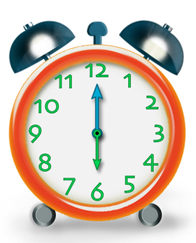
Set the time on the clock to 6 o'clock to start the game.
Starting with the adult, take it in turns to move the hands of the clock on by $\frac{1}{2}$ hour or 1 hour. For example, the adult could choose $\frac{1}{2}$ hour, so the clock hands move to 6.30, then you might choose 1 hour, moving the clock hands to 7.30, and so on.
The winner is the person who moves the hands exactly onto 12 o'clock.

Does it make a difference if you go first instead?
What happens if the adult gets to 10.30? Why?
Can you work out a winning strategy?


Notes for adults
Stop the clock helps to develop children's fluency with telling the time and calculating time intervals. However, the real challenge is to find a winning strategy!

Easier version: start at 9 o'clock instead of 6 o'clock.
Harder version: try using different time intervals e.g. $\frac{1}{4}$, $\frac{1}{2}$ or $\frac{3}{4}$ hour.

Repeat the game, aiming to find a winning strategy, then talk together about how it was found.

There's a classroom version of this game here.


You may also like
How Many Days?

How many days are there between February 25th 2000 and March 11th?

Planet Plex Time

On Planet Plex, there are only 6 hours in the day. Can you answer these questions about how Arog the Alien spends his day?

On What Day Did it Happen?

Read this article to find out the mathematical method for working out what day of the week each particular date fell on back as far as 1700.

  • Tech help
  • Accessibility Statement
  • Sign up to our newsletter
  • Twitter X logo

The NRICH Project aims to enrich the mathematical experiences of all learners. To support this aim, members of the NRICH team work in a wide range of capacities, including providing professional development for teachers wishing to embed rich mathematical tasks into everyday classroom practice.

NRICH is part of the family of activities in the Millennium Mathematics Project.

University of Cambridge logo NRICH logo