Skip over navigation


Answer: $25$
Using few unknowns
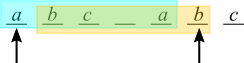
first + (middle 3) = (middle 3) + last $\therefore$ first = last, so the numbers indicated are equal



The code is:
Repeat for the 5s:
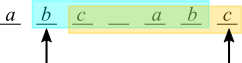
The code is:
Fours: $3a+x=16$
Fives: $4a+x=19$
$\therefore a=3$
All seven: $6a+x = 2a + (4a+x) = 6+19=25$
Using seven unknowns
Let the $7$-digit code be $abcdefg$.
We know that
$(1)$ $a+b+c+d=16$
$(2)$ $b+c+d+e=16$
$(3)$ $c+d+e+f=16$
$(4)$ $d+e+f+g=16$
$(5)$ $a+b+c+d+e=19$
$(6)$ $b+c+d+e+f=19$
$(7)$ $c+d+e+f+g=19$
If we take equation $(1)$ away from equation $(5)$ we obtain $e=3$.
Similarly:
$(6)-(2)$ gives that $f=3$,
$(7)-(3)$ gives that $g=3$,
$(5)-(2)$ gives that $a=3$,
$(6)-(3)$ gives that $b=3$ and
$(7)-(4)$ gives that $c=3$.
Then using equation $(1)$ we find that $d=7$.
So the code is $3337333$ and the sum of the digits is $25$.
Adjacent Additions
Age 14 to 16
ShortChallenge Level 

Answer: $25$
Using few unknowns
first + (middle 3) = (middle 3) + last $\therefore$ first = last, so the numbers indicated are equal
The code is:
Repeat for the 5s:
The code is:
Fours: $3a+x=16$
Fives: $4a+x=19$
$\therefore a=3$
All seven: $6a+x = 2a + (4a+x) = 6+19=25$
Using seven unknowns
Let the $7$-digit code be $abcdefg$.
We know that
$(1)$ $a+b+c+d=16$
$(2)$ $b+c+d+e=16$
$(3)$ $c+d+e+f=16$
$(4)$ $d+e+f+g=16$
$(5)$ $a+b+c+d+e=19$
$(6)$ $b+c+d+e+f=19$
$(7)$ $c+d+e+f+g=19$
If we take equation $(1)$ away from equation $(5)$ we obtain $e=3$.
Similarly:
$(6)-(2)$ gives that $f=3$,
$(7)-(3)$ gives that $g=3$,
$(5)-(2)$ gives that $a=3$,
$(6)-(3)$ gives that $b=3$ and
$(7)-(4)$ gives that $c=3$.
Then using equation $(1)$ we find that $d=7$.
So the code is $3337333$ and the sum of the digits is $25$.
This problem is taken from the UKMT Mathematical Challenges.
You can find more short problems, arranged by curriculum topic, in our short problems collection.
You may also like
Square It
Players take it in turns to choose a dot on the grid. The winner is the first to have four dots that can be joined to form a square.
Warmsnug Double Glazing
How have "Warmsnug" arrived at the prices shown on their windows? Which window has been given an incorrect price?