Skip over navigation
Cambridge University Faculty of Mathematics NRich logo
menu search
  • Teachers expand_more
    • Early years
    • Primary
    • Secondary
    • Post-16
    • Events
    • Professional development
  • Students expand_more
    • Primary
    • Secondary
    • Post-16
  • Parents expand_more
    • Early Years
    • Primary
    • Secondary
    • Post-16
  • Problem-Solving Schools
  • About NRICH expand_more
    • About us
    • Impact stories
    • Support us
    • Our funders
    • Contact us
  • search

Or search by topic

Number and algebra

  • The Number System and Place Value
  • Calculations and Numerical Methods
  • Fractions, Decimals, Percentages, Ratio and Proportion
  • Properties of Numbers
  • Patterns, Sequences and Structure
  • Algebraic expressions, equations and formulae
  • Coordinates, Functions and Graphs

Geometry and measure

  • Angles, Polygons, and Geometrical Proof
  • 3D Geometry, Shape and Space
  • Measuring and calculating with units
  • Transformations and constructions
  • Pythagoras and Trigonometry
  • Vectors and Matrices

Probability and statistics

  • Handling, Processing and Representing Data
  • Probability

Working mathematically

  • Thinking mathematically
  • Developing positive attitudes
  • Cross-curricular contexts

Advanced mathematics

  • Decision Mathematics and Combinatorics
  • Advanced Probability and Statistics
  • Mechanics
  • Calculus

For younger learners

  • Early Years Foundation Stage

Pumpkin Pie Problem

Age 7 to 11
Challenge Level Yellow starYellow star
Primary curriculum
  • Problem
  • Getting Started
  • Student Solutions
  • Teachers' Resources

Pumpkin Pie Problem


Peter, the pumpkin eater, wanted to make two pies for a party. His mother, a professional pie maker, had a recipe for him to use. However, she always made $80$ pies at a time. She used:
[copyright Microsoft]

$10$ dozen eggs
$27$ litres of condensed milk
$480$ tablespoons of sugar
$100$ teaspoons of cinnamon
$140$ cups of pumpkin

Peter looked in the cupboard and found:

$4$ cups of pumpkin
$2$ eggs
$1 \frac{1}{2}$ teaspoons of cinnamon
$\frac{2}{3}$ of a litre of condensed milk
$15$ tablespoons of sugar

Did Peter have enough ingredients to make two pumpkin pies for the party or did he need to buy more?


Why do this problem?

Ratio is a notoriously difficult topic and many teachers avoid it! There are many possible ways of solving this problem which make it ideal for class or group discussion, and offer opportunities to assess your children's understanding and misconceptions. You will need to allow time for a reasonable discussion.

Possible approach

Working in pairs gives the children opportunities to clarify their thinking. Give each pair a large piece of paper on which to record - many may want to draw pictures and working on small pieces of paper isn't helpful. Having explained the problem, provide each pair with the two lists (you can download a printable copy here).

Give a little time for the children to 'get into' the problem. When appropriate, draw the group or class together and ask what they have found useful to begin. Give more time for them to use some of these ideas, or continue with their own.

As each pair comes to a solution, ask them to prepare a new piece of paper which will help them to explain their working. Choose a confident pair to start and then invite each pair in turn to explain what they have done. The rest of the group can ask questions if clarification is needed.

Focus the children's attention on the different ways pairs have solved the problem but how all involve scaling amounts up and down - ratio and proportion.

Key questions

Can you paraphrase the question (ask it in a different way) to make it easier to understand?
What do we need to find out?

Possible extension

Most children will have focused on the eggs first as these are easier to calculate than litres, teaspoons etc. The question is then answered as no matter how much of everything else he has, he doesn't have enough eggs. Children who find this quite easy could be challenged to find out what additional other ingredients would have to be bought for two pies. What is the largest number of pies he could make without buying more of each ingredient?

Possible support

This is probably not a suitable question for children who struggle with the idea of doubling, halving and other simple ratio.


You may also like

Doplication

We can arrange dots in a similar way to the 5 on a dice and they usually sit quite well into a rectangular shape. How many altogether in this 3 by 5? What happens for other sizes?
Round and Round the Circle

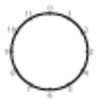
What happens if you join every second point on this circle? How about every third point? Try with different steps and see if you can predict what will happen.
Making Cuboids

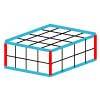
Let's say you can only use two different lengths - 2 units and 4 units. Using just these 2 lengths as the edges how many different cuboids can you make?

  • Tech help
  • Accessibility Statement
  • Sign up to our newsletter
  • Twitter X logo

The NRICH Project aims to enrich the mathematical experiences of all learners. To support this aim, members of the NRICH team work in a wide range of capacities, including providing professional development for teachers wishing to embed rich mathematical tasks into everyday classroom practice.

NRICH is part of the family of activities in the Millennium Mathematics Project.

University of Cambridge logo NRICH logo