Skip over navigation


In all these solutions, $t$ will represent the number of tiles, $I$ the inner perimeter and $O$ the outer perimeter.
Sameer, from Hymers College, was able to observe some patterns in the loops that he observed.
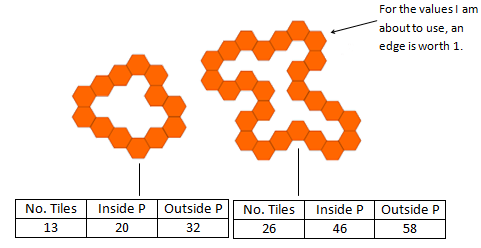
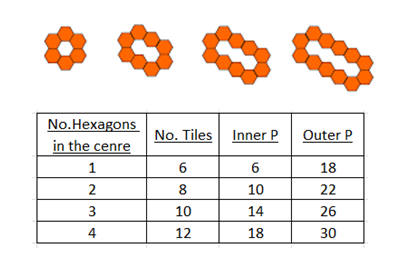
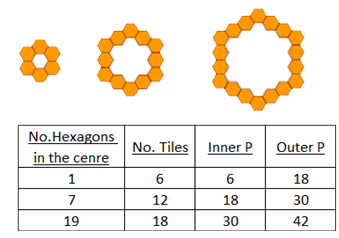
If we subtract 3 from the number of tiles and multiply the result by 2, we get the inside perimeter.
If we add 3 to the number of tiles and multiply the result by 2, we get the outside perimeter.
Here are the equations for that:
He was also able to make another useful observation:
The difference between the outer perimeter and the inner perimeter is always $12$.
Zach divided the hexagons into three types, depending on where they were in the loop:
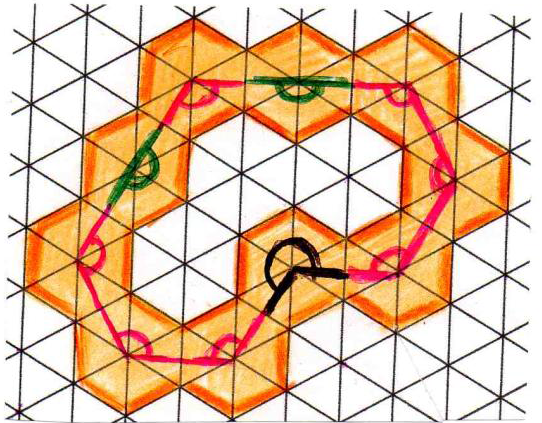
$120^\circ$ angles are marked in red, $180^\circ$ angles are marked in green and $240^\circ$ angles are marked in black.
Each $120^\circ$ angle hexagon contributes $1$ side to the inner perimeter, and $3$ sides to the outer perimeter.
Each $180^\circ$ angle hexagon contributes $2$ sides to both the inner and outer perimeters.
Each $240^\circ$ angle hexagon contributes $3$ sides to the inner perimeter and $1$ side to the outer perimeter.
He was then able to use this to count the number of faces in a very long loop:
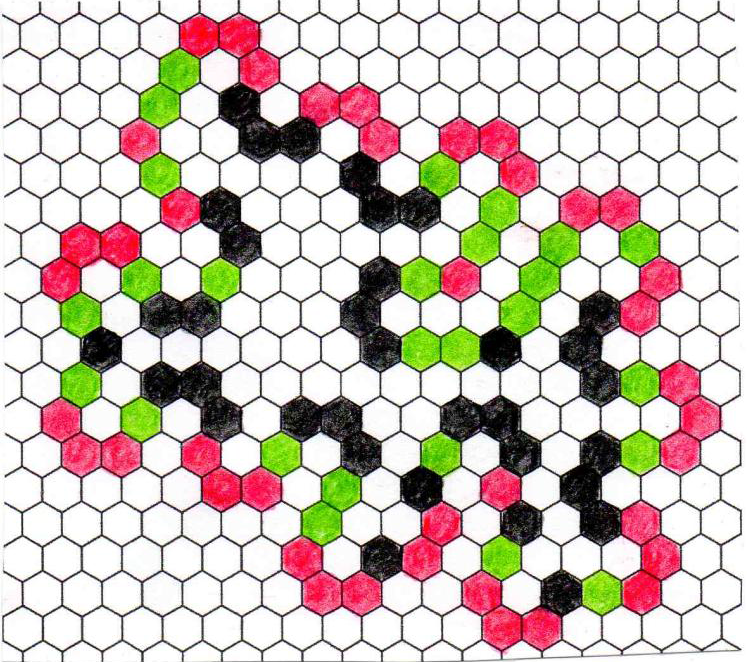

Zach was then able to confirm that these agreed with the rules he had found, which were the same as Sameer's
There are 100 hexagons in the loop, so $t = 100$. Then, $2t - 6 = 2 \times 100 - 6 = 194 = I$ and $2t+6 = 2 \times 100 + 6 = 206 = O$.
Raymond, from Greenacres Public School, Australia, provided some formulae from these observations to connect the numbers of the different types of tiles with the inner and outer perimeters.
Let $x$ be the numberof hexagons ONLY on a straight line, not a corner. (These are the $180^\circ$ or green hexagons from Zach's solution).
Let $y$ be the number of corner hexagons curving into the loop. (These are the $240^\circ$ or black hexagons from Zach's solution).
Let $z$ be the number of other corner hexagons. (These are the $120^\circ$ or red hexagons from Zach's solution).
Then:
$O = 2x + y + 3z$
$I = 2x + 3y + z$
Thank you to all of you for submitting your solutions - well done!
Since the hexagons must form a loop, there must be exactly six more outward ($120^\circ$ or red) hexagons than there are inward ($240^\circ$ or black) hexagons. You can check that this is true for both of Zach's examples. This happens because it takes six $120^\circ$ angles to form a loop, and each $240^\circ$ angle cancels one of these out, so there must be exactly six more.
This means $z=y+6$.
Also, as all the hexagons are of these three types, we know that $t = x+y+z$
Therefore:
$O = 2x + y + 3z = 2t + z - y = 2t + 6$
$I = 2x + 3y + z = 2t +y -z = 2t - 6$
These are exactly the patterns that Sameer noticed at the beginning! Now we know that these will always happen.

Regular Hexagon Loops
Age 11 to 14
Challenge Level 

In all these solutions, $t$ will represent the number of tiles, $I$ the inner perimeter and $O$ the outer perimeter.
Sameer, from Hymers College, was able to observe some patterns in the loops that he observed.
If we subtract 3 from the number of tiles and multiply the result by 2, we get the inside perimeter.
If we add 3 to the number of tiles and multiply the result by 2, we get the outside perimeter.
Here are the equations for that:
$\begin{eqnarray}
I &=& 2(t-3) \\
O &=& 2(t+3)
\end{eqnarray}$
I &=& 2(t-3) \\
O &=& 2(t+3)
\end{eqnarray}$
He was also able to make another useful observation:
The difference between the outer perimeter and the inner perimeter is always $12$.
Zach divided the hexagons into three types, depending on where they were in the loop:
$120^\circ$ angles are marked in red, $180^\circ$ angles are marked in green and $240^\circ$ angles are marked in black.
Each $120^\circ$ angle hexagon contributes $1$ side to the inner perimeter, and $3$ sides to the outer perimeter.
Each $180^\circ$ angle hexagon contributes $2$ sides to both the inner and outer perimeters.
Each $240^\circ$ angle hexagon contributes $3$ sides to the inner perimeter and $1$ side to the outer perimeter.
He was then able to use this to count the number of faces in a very long loop:
Zach was then able to confirm that these agreed with the rules he had found, which were the same as Sameer's
There are 100 hexagons in the loop, so $t = 100$. Then, $2t - 6 = 2 \times 100 - 6 = 194 = I$ and $2t+6 = 2 \times 100 + 6 = 206 = O$.
Raymond, from Greenacres Public School, Australia, provided some formulae from these observations to connect the numbers of the different types of tiles with the inner and outer perimeters.
Let $x$ be the numberof hexagons ONLY on a straight line, not a corner. (These are the $180^\circ$ or green hexagons from Zach's solution).
Let $y$ be the number of corner hexagons curving into the loop. (These are the $240^\circ$ or black hexagons from Zach's solution).
Let $z$ be the number of other corner hexagons. (These are the $120^\circ$ or red hexagons from Zach's solution).
Then:
$O = 2x + y + 3z$
$I = 2x + 3y + z$
Thank you to all of you for submitting your solutions - well done!
Since the hexagons must form a loop, there must be exactly six more outward ($120^\circ$ or red) hexagons than there are inward ($240^\circ$ or black) hexagons. You can check that this is true for both of Zach's examples. This happens because it takes six $120^\circ$ angles to form a loop, and each $240^\circ$ angle cancels one of these out, so there must be exactly six more.
This means $z=y+6$.
Also, as all the hexagons are of these three types, we know that $t = x+y+z$
Therefore:
$O = 2x + y + 3z = 2t + z - y = 2t + 6$
$I = 2x + 3y + z = 2t +y -z = 2t - 6$
These are exactly the patterns that Sameer noticed at the beginning! Now we know that these will always happen.
You may also like
Summing Consecutive Numbers
15 = 7 + 8 and 10 = 1 + 2 + 3 + 4. Can you say which numbers can be expressed as the sum of two or more consecutive integers?
Always the Same
Arrange the numbers 1 to 16 into a 4 by 4 array. Choose a number. Cross out the numbers on the same row and column. Repeat this process. Add up you four numbers. Why do they always add up to 34?
Fibs
The well known Fibonacci sequence is 1 ,1, 2, 3, 5, 8, 13, 21.... How many Fibonacci sequences can you find containing the number 196 as one of the terms?