Skip over navigation


There are a number of different approaches that can be used to solve this problem.
 Rotation
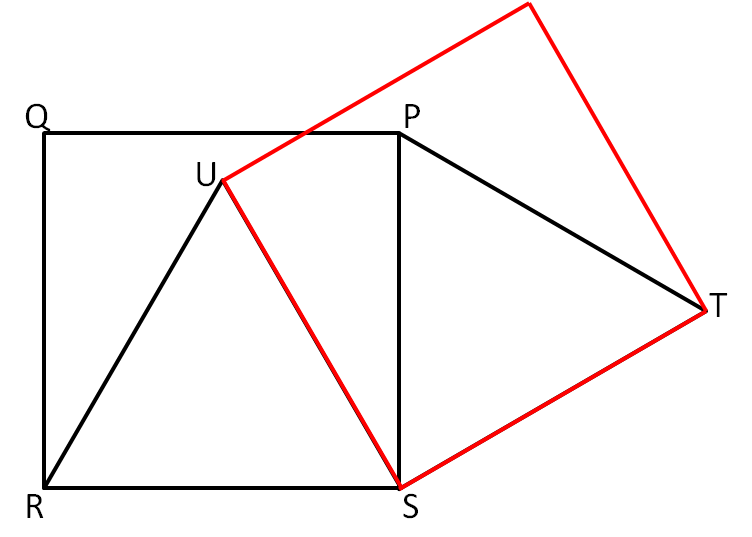
Consider rotating the square $60^\circ$ clockwise about $S$.
Since $PQRS$ is a square, and $PST$ and $RSU$ are equilateral, $SR = SU = SP = ST = 1$.
As $\angle PST = 60^\circ$ (as the interior angle of an equilateral triangle), $P$ rotates onto $T$.
As $\angle RSU = 60^\circ$ (as the interior angle of an equilateral triangle), $R$ rotates onto $U$.
This means that the distance $UT$ is the same as $PR$, since distances are not changed by rotation.
Then, as $\angle PSR = 90^\circ$, Pythagoras' theorem can be used on triangle $PSR$ to find that:
$PR = \sqrt{1^2+1^2} = \sqrt{2}$.
Hence, $UT= PR = \sqrt{2}$.
Right Angle
$\angle PSR = 90^\circ$, as it is in a square.
$\angle USR = \angle TSP = 60^\circ$, as they are in equilateral triangles.
Then, $\angle PSU = 90^\circ - 60^\circ = 30^\circ$.
$\angle TSU = 60^\circ + 30^\circ = 90^\circ$.
Thus, TSU is a right angled triangle, so using Pythagoras' theorem: $UT = \sqrt{1^2+1^2} = \sqrt{2}$
 Coordinates
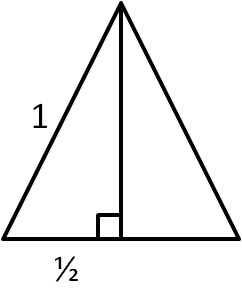
The height of an equilateral triangle of side length $1$ can be calculated to be, using Pythagoras' theorem:
An equilateral triangle of side length $1$ has height $\frac{\sqrt{3}}{2}$.
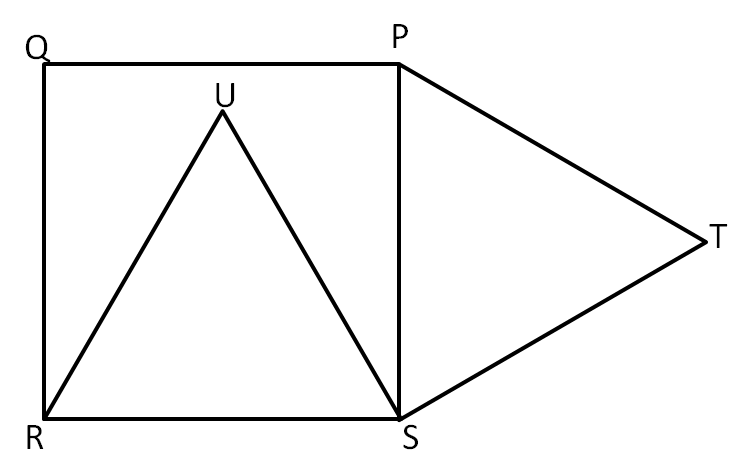 Let $R$ be the origin.
The coordinates of $U$ are $\left(\frac{1}{2},\frac{\sqrt{3}}{2} \right)$.
The coordinates of $T$ are $\left( 1 + \frac{\sqrt{3}}{2},\frac{1}{2} \right)$.
Then:
$UT = \sqrt{\left(1 + \frac{\sqrt{3}}{2} - \frac{1}{2}\right)^2 + \left( \frac{\sqrt{3}}{2} - \frac{1}{2} \right)^2}$
$= \sqrt{\left(\frac{3}{4} + \frac{2\sqrt{3}}{4} + \frac{1}{4}\right) + \left(\frac{3}{4} - \frac{2\sqrt{3}}{4} + \frac{1}{4}\right)}$
$=\sqrt{2}$

Internal - External
Age 14 to 16
ShortChallenge Level 

There are a number of different approaches that can be used to solve this problem.
RotationConsider rotating the square $60^\circ$ clockwise about $S$.
Since $PQRS$ is a square, and $PST$ and $RSU$ are equilateral, $SR = SU = SP = ST = 1$.
As $\angle PST = 60^\circ$ (as the interior angle of an equilateral triangle), $P$ rotates onto $T$.
As $\angle RSU = 60^\circ$ (as the interior angle of an equilateral triangle), $R$ rotates onto $U$.
This means that the distance $UT$ is the same as $PR$, since distances are not changed by rotation.
Then, as $\angle PSR = 90^\circ$, Pythagoras' theorem can be used on triangle $PSR$ to find that:
$PR = \sqrt{1^2+1^2} = \sqrt{2}$.
Hence, $UT= PR = \sqrt{2}$.
Right Angle
$\angle PSR = 90^\circ$, as it is in a square.
$\angle USR = \angle TSP = 60^\circ$, as they are in equilateral triangles.
Then, $\angle PSU = 90^\circ - 60^\circ = 30^\circ$.
$\angle TSU = 60^\circ + 30^\circ = 90^\circ$.
Thus, TSU is a right angled triangle, so using Pythagoras' theorem: $UT = \sqrt{1^2+1^2} = \sqrt{2}$
CoordinatesThe height of an equilateral triangle of side length $1$ can be calculated to be, using Pythagoras' theorem:
$\sqrt{1^2 - \left(\frac{1}{2}\right)^2} = \frac{\sqrt{3}}{2}$
An equilateral triangle of side length $1$ has height $\frac{\sqrt{3}}{2}$.
Let $R$ be the origin.The coordinates of $U$ are $\left(\frac{1}{2},\frac{\sqrt{3}}{2} \right)$.
The coordinates of $T$ are $\left( 1 + \frac{\sqrt{3}}{2},\frac{1}{2} \right)$.
Then:
$UT = \sqrt{\left(1 + \frac{\sqrt{3}}{2} - \frac{1}{2}\right)^2 + \left( \frac{\sqrt{3}}{2} - \frac{1}{2} \right)^2}$
$= \sqrt{\left(\frac{3}{4} + \frac{2\sqrt{3}}{4} + \frac{1}{4}\right) + \left(\frac{3}{4} - \frac{2\sqrt{3}}{4} + \frac{1}{4}\right)}$
$=\sqrt{2}$
This problem is taken from the UKMT Mathematical Challenges.
You can find more short problems, arranged by curriculum topic, in our short problems collection.
You may also like
Ladder and Cube
A 1 metre cube has one face on the ground and one face against a wall. A 4 metre ladder leans against the wall and just touches the cube. How high is the top of the ladder above the ground?
Bendy Quad
Four rods are hinged at their ends to form a convex quadrilateral. Investigate the different shapes that the quadrilateral can take. Be patient this problem may be slow to load.