Skip over navigation


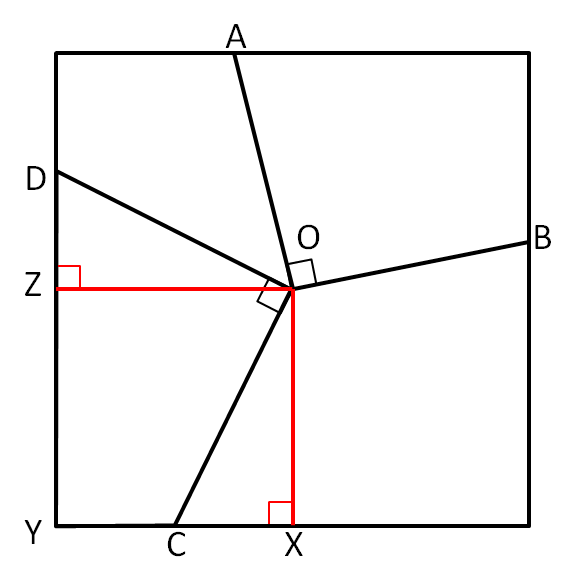 Consider connecting $O$ to $X$ and $Z$, both of which are the midpoints of the sides. Then, $OX = OZ$ as $O$ is the centre of the square, and $\angle OXC = 90 ^\circ = \angle OZD$.
Then, $\angle DOC = 90^\circ = \angle ZOX$, so: $\angle DOZ= 90^\circ - \angle ZOC = \angle COX$. This makes $DOZ$ and $COX$ congruent, as they have the same angles and one pair of corresponding sides the same length.
But then, $CODY$ and $ZOXY$ have the same areas, as they both attach one of these triangles to $COZY$. This is clearly a quarter of the large square.
There are two of these unshaded areas, and both have area one quarter that of the square. This means half the square is shaded, so $\frac{1}{2} \times 2^2 = 2\text{m}^2$.
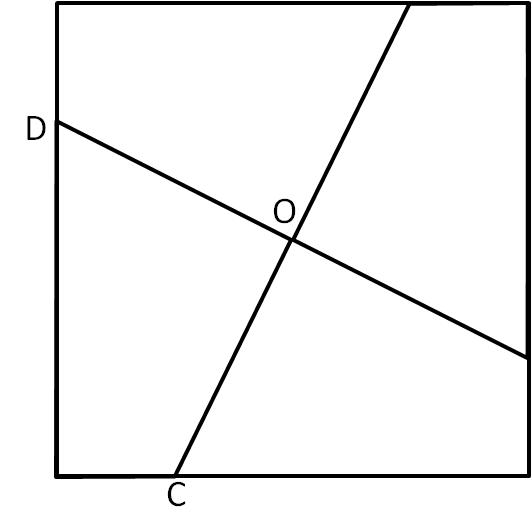
Alternatively, extending the lines from $D$ and $C$ past $O$ divides the square into four congruent pieces, since rotation by $90^\circ$ takes each piece to the next. Therefore, each unshaded area is one quarter of the total area of the square.
There are two of these unshaded areas, and both have area one quarter that of the square. This means half the square is shaded, so $\frac{1}{2} \times 2^2 = 2\text{m}^2$.

Shaded Square
Age 14 to 16
ShortChallenge Level 

Consider connecting $O$ to $X$ and $Z$, both of which are the midpoints of the sides. Then, $OX = OZ$ as $O$ is the centre of the square, and $\angle OXC = 90 ^\circ = \angle OZD$.Then, $\angle DOC = 90^\circ = \angle ZOX$, so: $\angle DOZ= 90^\circ - \angle ZOC = \angle COX$. This makes $DOZ$ and $COX$ congruent, as they have the same angles and one pair of corresponding sides the same length.
But then, $CODY$ and $ZOXY$ have the same areas, as they both attach one of these triangles to $COZY$. This is clearly a quarter of the large square.
There are two of these unshaded areas, and both have area one quarter that of the square. This means half the square is shaded, so $\frac{1}{2} \times 2^2 = 2\text{m}^2$.
Alternatively, extending the lines from $D$ and $C$ past $O$ divides the square into four congruent pieces, since rotation by $90^\circ$ takes each piece to the next. Therefore, each unshaded area is one quarter of the total area of the square.
There are two of these unshaded areas, and both have area one quarter that of the square. This means half the square is shaded, so $\frac{1}{2} \times 2^2 = 2\text{m}^2$.
This problem is taken from the UKMT Mathematical Challenges.
You can find more short problems, arranged by curriculum topic, in our short problems collection.
You may also like
Doodles
Draw a 'doodle' - a closed intersecting curve drawn without taking pencil from paper. What can you prove about the intersections?
Russian Cubes
I want some cubes painted with three blue faces and three red faces. How many different cubes can be painted like that?
Polycircles
Show that for any triangle it is always possible to construct 3 touching circles with centres at the vertices. Is it possible to construct touching circles centred at the vertices of any polygon?