Skip over navigation


Answer: 20%
Using inverse operations
100% + 25% = 1 + $\frac14$ = $\frac54$
time $\times$ speed = distance
 $\times \frac54$ $\times$ ? $\times$ 1 because distance does not change
(new time) $\times$ (new speed) = distance
$\frac 54 \times$ ? = 1, so ? = $\frac45$ = 80%
80% of original time is a 20% reduction
Using a speed-time graph

The area on a speed-time graph represents distance.
Green rectangle - normal day
Yellow rectangle - traffic jam
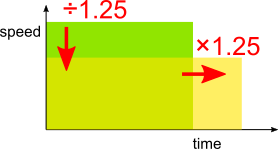 The rectangles have the same area since the distance is still the same
Horizontal scale factor $\times$ 125% = 1.25
So vertical scale factor is the inverse
$\div$ 1.25 = $\div \frac54$ = $\times \frac45$ = $\times$ 80%
80% of original time is a 20% reduction
Using algebra
Write $d$ for the distance of Emily's journey, and $t$ for the time it usually takes her. Then, in normal circumstances, her average speed is $\frac{d}{t}$.
Yesterday, her journey took $25\%$ longer than usual, meaning an increase of $0.25t$, so the time was $1.25t$. The distance was the same as usual.
Her average speed was therefore $\frac{d}{1.25t} = \frac{1}{1.25} \times \frac{d}{t} = 0.8\frac{d}{t}$. This means she travelled at $0.8$ of her usual average speed, which is a reduction of $0.2$ or $20\%$.


Traffic Jam
Age 14 to 16
ShortChallenge Level 
Answer: 20%
Using inverse operations
100% + 25% = 1 + $\frac14$ = $\frac54$
time $\times$ speed = distance
$\times \frac54$ $\times$ ? $\times$ 1 because distance does not change(new time) $\times$ (new speed) = distance
$\frac 54 \times$ ? = 1, so ? = $\frac45$ = 80%
80% of original time is a 20% reduction
Using a speed-time graph
The area on a speed-time graph represents distance.
Green rectangle - normal day
Yellow rectangle - traffic jam
The rectangles have the same area since the distance is still the sameHorizontal scale factor $\times$ 125% = 1.25
So vertical scale factor is the inverse
$\div$ 1.25 = $\div \frac54$ = $\times \frac45$ = $\times$ 80%
80% of original time is a 20% reduction
Using algebra
Write $d$ for the distance of Emily's journey, and $t$ for the time it usually takes her. Then, in normal circumstances, her average speed is $\frac{d}{t}$.
Yesterday, her journey took $25\%$ longer than usual, meaning an increase of $0.25t$, so the time was $1.25t$. The distance was the same as usual.
Her average speed was therefore $\frac{d}{1.25t} = \frac{1}{1.25} \times \frac{d}{t} = 0.8\frac{d}{t}$. This means she travelled at $0.8$ of her usual average speed, which is a reduction of $0.2$ or $20\%$.
This problem is taken from the UKMT Mathematical Challenges.
You can find more short problems, arranged by curriculum topic, in our short problems collection.
You may also like

Ladder and Cube
A 1 metre cube has one face on the ground and one face against a wall. A 4 metre ladder leans against the wall and just touches the cube. How high is the top of the ladder above the ground?
Bendy Quad
Four rods are hinged at their ends to form a convex quadrilateral. Investigate the different shapes that the quadrilateral can take. Be patient this problem may be slow to load.