Skip over navigation


There are a number of different possible ways of solving this problem, which are presented below.
Solution 1
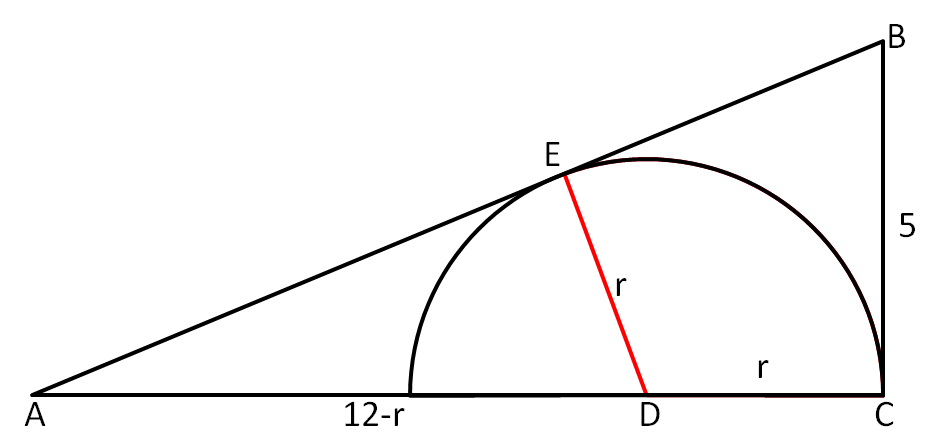
Since the semicircle touches the line $AB$, it is tangent there, so $\angle DEA = 90^\circ$. But then $\angle EAD = \angle CAB$, as these are the same angle. This means the triangles $ADE$ and $ABC$ are similar.
If the radius of the semicircle is $r$, then $DE = DC = r$ and $AD = 12-r$. Then, similarity says that:
Therefore:
Clearing the denominators gives:
Expanding the brackets and collecting like terms gives:
Therefore, $r = 3\frac{1}{3} \text{cm}$.
Solution 2
Again, write $r$ for the radius of the semicircle.
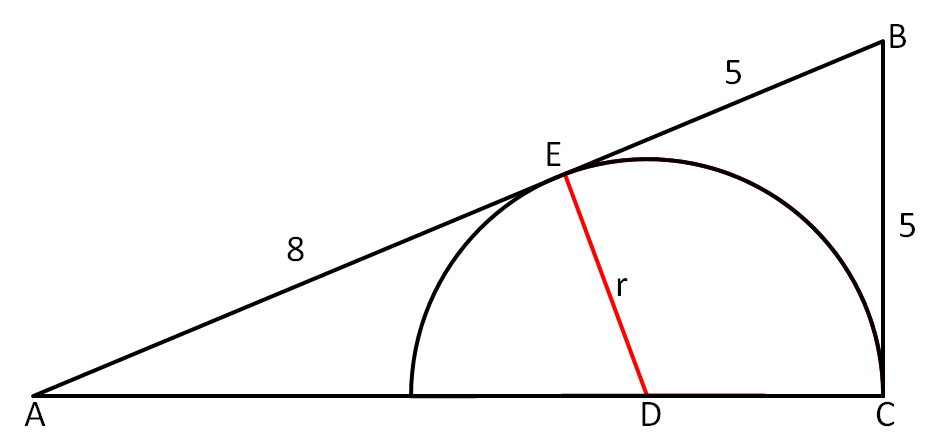
As in solution 1, we can prove that $ADE$ is similar to $ABC$. Since the semicircle touches the line $AB$, it is tangent there, so $\angle DEA = 90^\circ$. But then $\angle EAD = \angle CAB$, as these are the same angle. This means the triangles $ADE$ and $ABC$ are similar.
Then, since $\angle DCB$ is a right angle, also, $CB$ and $EB$ are both tangents of the semicircle. Since they intersect, $EB = CB = 5$, so $AE = 13-5=8$.
Then, similarity says:
Therefore:
Multiplying by $8$ gives:
This means the semicircle has radius $3\frac 13 \text{cm}$.
Solution 3
This approach uses Pythagoras' theorem, rather than similarity, to solve the problem. Write $r$ for the radius of the semicircle.
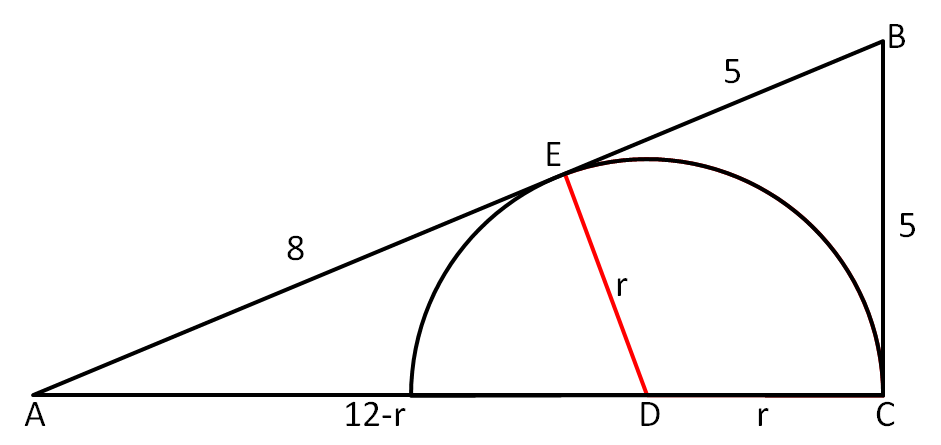
Since $AB$ is tangent to the semicircle at $E$, $\angle AED$ is a right angle.
Also, as $BC$ is tangent to the semicircle at $C$, as $\angle ACD$ is a right angle, the lengths $BC$ and $BE$ are the same length, so both are $5\text{cm}$.
This then means that $AE = 8$, $DE = r$ and $AD = 12-r$.
Now, Pythagoras' theorem says that, since $\angle AED$ is a right angle:
That is:
Expanding the brackets gives:
Then, cancelling terms gives:
Therefore, $r = \frac{24}{80} = 3\frac 13$, so the radius of the semicircle is $3\frac 13\text{cm}$.

Inscribed Semicircle
Age 14 to 16
ShortChallenge Level 

There are a number of different possible ways of solving this problem, which are presented below.
Solution 1
Since the semicircle touches the line $AB$, it is tangent there, so $\angle DEA = 90^\circ$. But then $\angle EAD = \angle CAB$, as these are the same angle. This means the triangles $ADE$ and $ABC$ are similar.
If the radius of the semicircle is $r$, then $DE = DC = r$ and $AD = 12-r$. Then, similarity says that:
$\frac{AB}{BC} = \frac{AD}{DE}$
Therefore:
$\frac{13}{5}=\frac{12-r}{r}$
Clearing the denominators gives:
$13r = 5(12-r)$
Expanding the brackets and collecting like terms gives:
$18r = 60$
Therefore, $r = 3\frac{1}{3} \text{cm}$.
Solution 2
Again, write $r$ for the radius of the semicircle.
As in solution 1, we can prove that $ADE$ is similar to $ABC$. Since the semicircle touches the line $AB$, it is tangent there, so $\angle DEA = 90^\circ$. But then $\angle EAD = \angle CAB$, as these are the same angle. This means the triangles $ADE$ and $ABC$ are similar.
Then, since $\angle DCB$ is a right angle, also, $CB$ and $EB$ are both tangents of the semicircle. Since they intersect, $EB = CB = 5$, so $AE = 13-5=8$.
Then, similarity says:
$\frac{DE}{AE}=\frac{BC}{AC}$
Therefore:
$\frac{r}{8}=\frac{5}{12}$
Multiplying by $8$ gives:
$r = \frac{40}{12} = 3\frac{1}{3}$
This means the semicircle has radius $3\frac 13 \text{cm}$.
Solution 3
This approach uses Pythagoras' theorem, rather than similarity, to solve the problem. Write $r$ for the radius of the semicircle.
Since $AB$ is tangent to the semicircle at $E$, $\angle AED$ is a right angle.
Also, as $BC$ is tangent to the semicircle at $C$, as $\angle ACD$ is a right angle, the lengths $BC$ and $BE$ are the same length, so both are $5\text{cm}$.
This then means that $AE = 8$, $DE = r$ and $AD = 12-r$.
Now, Pythagoras' theorem says that, since $\angle AED$ is a right angle:
$AD^2 = AE^2 + DE^2$
That is:
$(12-r)^2 = 8^2 + r^2$
Expanding the brackets gives:
$r^2 - 24r+144 = r^2 + 64$
Then, cancelling terms gives:
$24r = 80$
Therefore, $r = \frac{24}{80} = 3\frac 13$, so the radius of the semicircle is $3\frac 13\text{cm}$.
This problem is taken from the UKMT Mathematical Challenges.
You can find more short problems, arranged by curriculum topic, in our short problems collection.
You may also like
Ladder and Cube
A 1 metre cube has one face on the ground and one face against a wall. A 4 metre ladder leans against the wall and just touches the cube. How high is the top of the ladder above the ground?
Bendy Quad
Four rods are hinged at their ends to form a convex quadrilateral. Investigate the different shapes that the quadrilateral can take. Be patient this problem may be slow to load.