Skip over navigation



Snapped Palm Tree
Age 14 to 16
ShortChallenge Level 

Labelling the two parts of the trunk
Suppose the vertical part of the trunk is $a$ and the slanted part is $b$, where $a$ and $b$ are in metres, as shown below.
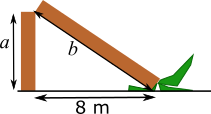
Then $a+b=16$, and $a$, $b$ and 8 are the sides of a right-angled triangle with hypotenuse $b$, so $a^2+8^2=b^2$.
This gives us the simultaneous equations $a+b=16$ and $a^2+64=b^2$.
Solving by substitution of $b$
Since we want $a$, it is sensible to make $b$ the subject of one of the equations and then substitute that into the other one.
$a+b=16$, so $b=16-a$.
Substituting that into the other equation gives $$\begin{align}a^2+64&=\left(16-a\right)^2\\
a^2+64&=256-32a+a^2\\
64&=256-32a\\
32a&=256-64\\
32a&=192\\
a&=6\end{align}$$
So the height of the part of the trunk that is still standing is 6 metres.
Solving by substitution of $b^2$
Since we want $a$, it is sensible to use substitution to remove $b$ from the equations. As $b^2$ is already the subject of the second equation, we could also make $b^2$ the subject of the first equation, and then equate them.
$$\begin{align}a+b&=16\\
b&=16-a\\
b^2&=\left(16-a\right)^2\\
b^2&=256-32a+a^2\end{align}$$
But from the second equation, $b^2=a^2+64$, so
$$\begin{align}a^2+64&=256-32a+a^2\\
64&=256-32a\\
32a&=256-64\\
32a&=192\\
a&=6\end{align}$$
So the height of the part of the trunk that is still standing is 6 metres.
Labelling the parts of the trunk in terms of the height
The total length of the trunk of the palm tree was 16 metres, so if the height of the part that is still standing is $h$, where $h$ is in metres, then the slanted section must be 16$-h$. This is labelled in the diagram below.
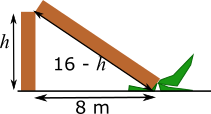
The three lengths labelled in the diagram form a right-angled triangle with hypotenuse $16-h$, so $h^2+8^2=\left(16-h\right)^2$ by Pythagoras.
Solving for $h$,
$$\begin{align}h^2+8^2&=\left(16-h\right)^2\\
h^2+64&=256-32h+h^2\\
64&=256-32h\\
32h&=256-64\\
32h&=192\\
h&=6\end{align}$$
So the height of the part of the trunk that is still standing is 6 metres.
Suppose the vertical part of the trunk is $a$ and the slanted part is $b$, where $a$ and $b$ are in metres, as shown below.
Then $a+b=16$, and $a$, $b$ and 8 are the sides of a right-angled triangle with hypotenuse $b$, so $a^2+8^2=b^2$.
This gives us the simultaneous equations $a+b=16$ and $a^2+64=b^2$.
Solving by substitution of $b$
Since we want $a$, it is sensible to make $b$ the subject of one of the equations and then substitute that into the other one.
$a+b=16$, so $b=16-a$.
Substituting that into the other equation gives $$\begin{align}a^2+64&=\left(16-a\right)^2\\
a^2+64&=256-32a+a^2\\
64&=256-32a\\
32a&=256-64\\
32a&=192\\
a&=6\end{align}$$
So the height of the part of the trunk that is still standing is 6 metres.
Solving by substitution of $b^2$
Since we want $a$, it is sensible to use substitution to remove $b$ from the equations. As $b^2$ is already the subject of the second equation, we could also make $b^2$ the subject of the first equation, and then equate them.
$$\begin{align}a+b&=16\\
b&=16-a\\
b^2&=\left(16-a\right)^2\\
b^2&=256-32a+a^2\end{align}$$
But from the second equation, $b^2=a^2+64$, so
$$\begin{align}a^2+64&=256-32a+a^2\\
64&=256-32a\\
32a&=256-64\\
32a&=192\\
a&=6\end{align}$$
So the height of the part of the trunk that is still standing is 6 metres.
Labelling the parts of the trunk in terms of the height
The total length of the trunk of the palm tree was 16 metres, so if the height of the part that is still standing is $h$, where $h$ is in metres, then the slanted section must be 16$-h$. This is labelled in the diagram below.
The three lengths labelled in the diagram form a right-angled triangle with hypotenuse $16-h$, so $h^2+8^2=\left(16-h\right)^2$ by Pythagoras.
Solving for $h$,
$$\begin{align}h^2+8^2&=\left(16-h\right)^2\\
h^2+64&=256-32h+h^2\\
64&=256-32h\\
32h&=256-64\\
32h&=192\\
h&=6\end{align}$$
So the height of the part of the trunk that is still standing is 6 metres.
You can find more short problems, arranged by curriculum topic, in our short problems collection.
You may also like
Some(?) of the Parts
A circle touches the lines OA, OB and AB where OA and OB are perpendicular. Show that the diameter of the circle is equal to the perimeter of the triangle
Ladder and Cube
A 1 metre cube has one face on the ground and one face against a wall. A 4 metre ladder leans against the wall and just touches the cube. How high is the top of the ladder above the ground?
Bendy Quad
Four rods are hinged at their ends to form a convex quadrilateral. Investigate the different shapes that the quadrilateral can take. Be patient this problem may be slow to load.