Skip over navigation


Answer: 40 seconds
Using proportion
In 24 seconds: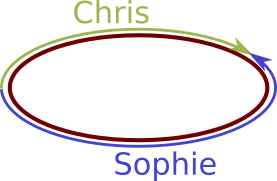

Backwards Laps
Age 14 to 16
ShortChallenge Level 
Answer: 40 seconds
Using proportion
In 24 seconds:
Chris runs $\frac{24}{60}=\frac{2}{5}$ of a lap in 24 seconds
Sophie runs $1-\frac25=\frac{3}{5}$ of a lap in 24 seconds
$\frac{1}{5}$ of a lap in 24$\div$3 = 8 seconds
1 whole lap in 8$\times$5 = 40 seconds
OR
Chris runs $\frac25$ of a lap while Sophie runs $\frac35$ of a lap
$\therefore$ the distances they run in a fixed time are in the ratio $2:3$
$\therefore$ the times they take to run a fixed distance are in the ratio $3:2$
$3:2$ is equivalent to $60:40$
Using a Travel Diagram
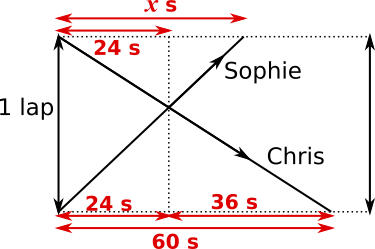
The diagram below shows time horizontally and distance vertically, with lines sloping in opposite directions for Sophie's journey and Chris' journey, because they run in opposite directions.
They begin one full lap apart, which is actually when they are in the same place, and their paths cross again after 24 seconds.
The triangles coloured yellow in the diagram below are congruent, because of the symmetry in the diagram.
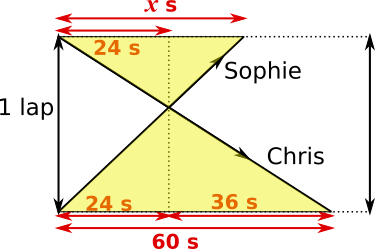
So, using scale factors within the triangles, $\dfrac{x}{24}=\dfrac{60}{36}\Rightarrow x=\dfrac{60}{36}\times24=40$
Or using scale factors between the triangles, $\dfrac{x}{60}=\dfrac{24}{36}\Rightarrow x=\dfrac{24}{36}\times60 = 40$
So Sophie runs a lap in 40 seconds.
Sophie runs $1-\frac25=\frac{3}{5}$ of a lap in 24 seconds
$\frac{1}{5}$ of a lap in 24$\div$3 = 8 seconds
1 whole lap in 8$\times$5 = 40 seconds
OR
Chris runs $\frac25$ of a lap while Sophie runs $\frac35$ of a lap
$\therefore$ the distances they run in a fixed time are in the ratio $2:3$
$\therefore$ the times they take to run a fixed distance are in the ratio $3:2$
$3:2$ is equivalent to $60:40$
Using a Travel Diagram
The diagram below shows time horizontally and distance vertically, with lines sloping in opposite directions for Sophie's journey and Chris' journey, because they run in opposite directions.
They begin one full lap apart, which is actually when they are in the same place, and their paths cross again after 24 seconds.
The triangles coloured yellow in the diagram below are congruent, because of the symmetry in the diagram.
So, using scale factors within the triangles, $\dfrac{x}{24}=\dfrac{60}{36}\Rightarrow x=\dfrac{60}{36}\times24=40$
Or using scale factors between the triangles, $\dfrac{x}{60}=\dfrac{24}{36}\Rightarrow x=\dfrac{24}{36}\times60 = 40$
So Sophie runs a lap in 40 seconds.
You can find more short problems, arranged by curriculum topic, in our short problems collection.
You may also like
Tummy Ache
Timmy, Tammy and Tommy all go to the doctors. In what order do they arrive at the surgery?