Skip over navigation




Flipping Coins
Age 14 to 16
ShortChallenge Level 

Using a tree diagram
The tree diagram below shows all of the possible outcomes, where the stages are the outcome of the first flip, the second flip, the third flip and the fourth flip. Green arrows indicate the outcomes with at least 3 heads.
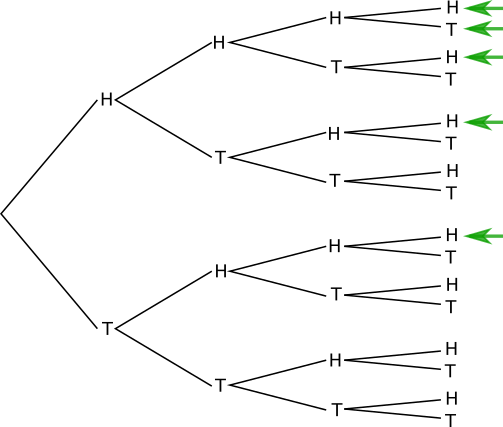
At each stage, the probability of getting heads is $\frac{1}{2}$ and the probability of getting tails is $\frac{1}{2}$. So every single branch in the tree diagram should be labelled with probability $\frac{1}{2}$.
So the probability of getting to each of the green arrows is $\frac{1}{2}\times\frac{1}{2}\times\frac{1}{2}\times\frac{1}{2}=\frac{1}{16}$. There are 5 green arrows, so the probability of getting heads at least 3 times is $\frac{5}{16}$.
Counting all of the possible outcomes
The first flip could either result in a head or a tail, and, whether it is a head or a tail, there are still 2 options for the second flip, giving a total of 4 outcomes for the first two flips.
Similarly, there are a total of 8 outcomes after 3 flips, and 16 after 4 flips.
Of these outcomes, there is only one way to get heads 4 times (HHHH). There are 4 ways to get heads 3 times (HHHT, HHTH, HTHH, THHH). This means there are a total of 5 ways of getting heads at least 3 times.
Any sequence of heads and tails has the same probability, because on each flip, a heads is as likely as a tails, regardless of what has happened so far. So the probability of getting heads at least 3 times is $\frac{5}{16}$.
The tree diagram below shows all of the possible outcomes, where the stages are the outcome of the first flip, the second flip, the third flip and the fourth flip. Green arrows indicate the outcomes with at least 3 heads.
At each stage, the probability of getting heads is $\frac{1}{2}$ and the probability of getting tails is $\frac{1}{2}$. So every single branch in the tree diagram should be labelled with probability $\frac{1}{2}$.
So the probability of getting to each of the green arrows is $\frac{1}{2}\times\frac{1}{2}\times\frac{1}{2}\times\frac{1}{2}=\frac{1}{16}$. There are 5 green arrows, so the probability of getting heads at least 3 times is $\frac{5}{16}$.
Counting all of the possible outcomes
The first flip could either result in a head or a tail, and, whether it is a head or a tail, there are still 2 options for the second flip, giving a total of 4 outcomes for the first two flips.
Similarly, there are a total of 8 outcomes after 3 flips, and 16 after 4 flips.
Of these outcomes, there is only one way to get heads 4 times (HHHH). There are 4 ways to get heads 3 times (HHHT, HHTH, HTHH, THHH). This means there are a total of 5 ways of getting heads at least 3 times.
Any sequence of heads and tails has the same probability, because on each flip, a heads is as likely as a tails, regardless of what has happened so far. So the probability of getting heads at least 3 times is $\frac{5}{16}$.
You can find more short problems, arranged by curriculum topic, in our short problems collection.
You may also like
Ladder and Cube
A 1 metre cube has one face on the ground and one face against a wall. A 4 metre ladder leans against the wall and just touches the cube. How high is the top of the ladder above the ground?
Bendy Quad
Four rods are hinged at their ends to form a convex quadrilateral. Investigate the different shapes that the quadrilateral can take. Be patient this problem may be slow to load.