Skip over navigation



Two Equilateral Triangles
Age 14 to 16
ShortChallenge Level 
Using rotation
Consider the coloured triangles in the diagram below. They both have one side equal in length to the larger equilateral triangle, and these sides are at an angle of 60$^\text{o}$ to each other. They also both have one side equal in length to the smaller equilateral triangle, and these sides are also at an angle of 60$^\text{o}$ to each other.
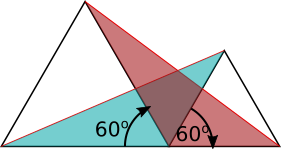
So a 60$^\text{o}$ rotation will map the blue triangle onto the red triangle. So the two triangles must be congruent. So the third sides, which are the red lengths, must be equal.
Using 'side angle side'
Let the sides of the larger equilateral triangle have length $a$ and the sides of the smaller equilateral triangle have length $b$, as labeled in the diagram. Notice that both the red triangle and the blue triangle contain an angle of 120$^\text{o}$ between sides of length $a$ and $b$.
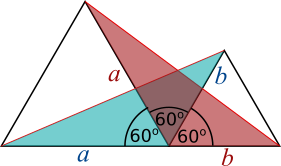
The lengths of the two sides and the size of the angle in between them uniquely define a triangle (imagine putting the ends of two sticks together at a fixed angle, joining the other ends of the sticks would complete the triangle). So the two triangles must be congruent, which means the third lengths must also be the same.
Consider the coloured triangles in the diagram below. They both have one side equal in length to the larger equilateral triangle, and these sides are at an angle of 60$^\text{o}$ to each other. They also both have one side equal in length to the smaller equilateral triangle, and these sides are also at an angle of 60$^\text{o}$ to each other.
So a 60$^\text{o}$ rotation will map the blue triangle onto the red triangle. So the two triangles must be congruent. So the third sides, which are the red lengths, must be equal.
Using 'side angle side'
Let the sides of the larger equilateral triangle have length $a$ and the sides of the smaller equilateral triangle have length $b$, as labeled in the diagram. Notice that both the red triangle and the blue triangle contain an angle of 120$^\text{o}$ between sides of length $a$ and $b$.
The lengths of the two sides and the size of the angle in between them uniquely define a triangle (imagine putting the ends of two sticks together at a fixed angle, joining the other ends of the sticks would complete the triangle). So the two triangles must be congruent, which means the third lengths must also be the same.
You can find more short problems, arranged by curriculum topic, in our short problems collection.
You may also like
Some(?) of the Parts
A circle touches the lines OA, OB and AB where OA and OB are perpendicular. Show that the diameter of the circle is equal to the perimeter of the triangle
Ladder and Cube
A 1 metre cube has one face on the ground and one face against a wall. A 4 metre ladder leans against the wall and just touches the cube. How high is the top of the ladder above the ground?
Bendy Quad
Four rods are hinged at their ends to form a convex quadrilateral. Investigate the different shapes that the quadrilateral can take. Be patient this problem may be slow to load.