Skip over navigation


Using scale factors
Notice that, in each case, the side length (or radius/diameter) of the smaller shape is exactly half of the side length (or radius/diameter) of the larger shape. So the length scale factor in each case is $\frac{1}{2}$.
This means that the area scale factor between the larger shapes and the smaller shapes is $\frac{1}{4}$. So $\frac{1}{4}$ of each pendant will be blue.
Using shapes and areas
For the rhombus, either of these diagrams are helpful.
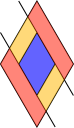
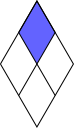
From the right-hand diagram, since the blue shape's sides are half the length of the large shape's sides, the yellow areas add up to the blue area, and the yellow area added to the blue area is equal to the sum of the red areas. So the blue area occupies $\frac{1}{4}$ of the total area.
From the left-hand diagram, the four small rhombi are all congruent, because they all have side length equal to half that of the larger rhombus. So the blue area occupies $\frac{1}{4}$ of the total area.
For the hexagon, part of a 'honeycomb' pattern is helpful.

The two green hexagons are congruent to the blue hexagon, and notice that the three yellow pieces can be stuck together to make a fourth hexagon. So the blue area occupies $\frac{1}{4}$ of the total area.
For the circle, the area of the large circle is $\pi \times 16^2=256\pi$, and the area of the smaller circle is $\pi\times 8^2=64\pi$, which is $\frac{1}{4}$ of $256\pi$. So the blue area occupies $\frac{1}{4}$ of the total area.

Pendants
Age 14 to 16
ShortChallenge Level 

Using scale factors
Notice that, in each case, the side length (or radius/diameter) of the smaller shape is exactly half of the side length (or radius/diameter) of the larger shape. So the length scale factor in each case is $\frac{1}{2}$.
This means that the area scale factor between the larger shapes and the smaller shapes is $\frac{1}{4}$. So $\frac{1}{4}$ of each pendant will be blue.
Using shapes and areas
For the rhombus, either of these diagrams are helpful.
From the right-hand diagram, since the blue shape's sides are half the length of the large shape's sides, the yellow areas add up to the blue area, and the yellow area added to the blue area is equal to the sum of the red areas. So the blue area occupies $\frac{1}{4}$ of the total area.
From the left-hand diagram, the four small rhombi are all congruent, because they all have side length equal to half that of the larger rhombus. So the blue area occupies $\frac{1}{4}$ of the total area.
For the hexagon, part of a 'honeycomb' pattern is helpful.
The two green hexagons are congruent to the blue hexagon, and notice that the three yellow pieces can be stuck together to make a fourth hexagon. So the blue area occupies $\frac{1}{4}$ of the total area.
For the circle, the area of the large circle is $\pi \times 16^2=256\pi$, and the area of the smaller circle is $\pi\times 8^2=64\pi$, which is $\frac{1}{4}$ of $256\pi$. So the blue area occupies $\frac{1}{4}$ of the total area.
You can find more short problems, arranged by curriculum topic, in our short problems collection.
You may also like
Ladder and Cube
A 1 metre cube has one face on the ground and one face against a wall. A 4 metre ladder leans against the wall and just touches the cube. How high is the top of the ladder above the ground?
Bendy Quad
Four rods are hinged at their ends to form a convex quadrilateral. Investigate the different shapes that the quadrilateral can take. Be patient this problem may be slow to load.