Skip over navigation


Labelling the width of the river as $d$ and the height of the tower as $h$, as shown below, we can then use trigonometry.
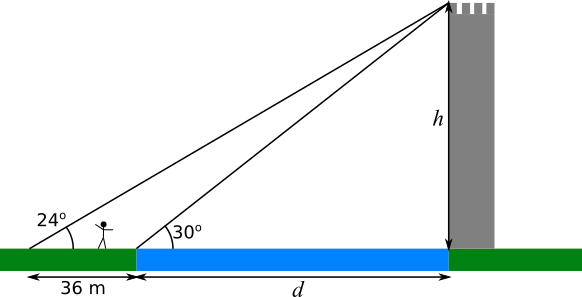
From the triangle containing the 30$^\text{o}$ angle, $\tan{30}=\dfrac{h}{d}\Rightarrow d\tan{30}=h$.
From the triangle containing the 24$^\text{o}$ angle, $\tan{24}=\dfrac{h}{d+36}\Rightarrow (d+36)\tan{24}=h$.
These are simultaneous equations in $h$ and $d$ (since $\tan{30}$ and $\tan{24}$ are just numbers, which can be found using a calculator at any point).
Solving by substitution
The aim is to get $h$ on its own, so making $d$ the subject of the first equation gives $d=\dfrac{h}{\tan{30}}$.
Substituting this into the second equation gives $$\begin{align}&\left(\dfrac{h}{\tan{30}}+36\right)\tan{24}=h\\
\Rightarrow&\frac{h\tan{24}}{\tan{30}}+36\tan{24}=h\\
\Rightarrow&36\tan{24}=h-h\dfrac{\tan{24}}{\tan{30}}\\
\Rightarrow&36\tan{24}=h\left(1-\dfrac{\tan{24}}{\tan{30}}\right)\\
\Rightarrow&36\tan{24}=h\left(\dfrac{\tan{30}-\tan{24}}{\tan{30}}\right)\\
\Rightarrow&36\tan{24}\dfrac{\tan{30}}{\tan{30}-\tan{24}}=h\\
\Rightarrow &70.041=h\end{align}$$
So the tower is 70 metres tall.
Finding $d$ then $h$
If $d\tan{30}=h$ and $(d+36)\tan{24}=h,$ then $d\tan{30}=(d+36)\tan{24}.$ So $d\tan{30}-d\tan{24}=36\tan{24}$, so $d=\dfrac{36\tan{24}}{\tan{30}-\tan{24}}=121.31.$
And $d\tan{30}=h,$ so $h=\tan{30}\times 121.31=70.041$. So the tower is 70 metres tall.

Height of the Tower
Age 14 to 16
ShortChallenge Level 
Labelling the width of the river as $d$ and the height of the tower as $h$, as shown below, we can then use trigonometry.
From the triangle containing the 30$^\text{o}$ angle, $\tan{30}=\dfrac{h}{d}\Rightarrow d\tan{30}=h$.
From the triangle containing the 24$^\text{o}$ angle, $\tan{24}=\dfrac{h}{d+36}\Rightarrow (d+36)\tan{24}=h$.
These are simultaneous equations in $h$ and $d$ (since $\tan{30}$ and $\tan{24}$ are just numbers, which can be found using a calculator at any point).
Solving by substitution
The aim is to get $h$ on its own, so making $d$ the subject of the first equation gives $d=\dfrac{h}{\tan{30}}$.
Substituting this into the second equation gives $$\begin{align}&\left(\dfrac{h}{\tan{30}}+36\right)\tan{24}=h\\
\Rightarrow&\frac{h\tan{24}}{\tan{30}}+36\tan{24}=h\\
\Rightarrow&36\tan{24}=h-h\dfrac{\tan{24}}{\tan{30}}\\
\Rightarrow&36\tan{24}=h\left(1-\dfrac{\tan{24}}{\tan{30}}\right)\\
\Rightarrow&36\tan{24}=h\left(\dfrac{\tan{30}-\tan{24}}{\tan{30}}\right)\\
\Rightarrow&36\tan{24}\dfrac{\tan{30}}{\tan{30}-\tan{24}}=h\\
\Rightarrow &70.041=h\end{align}$$
So the tower is 70 metres tall.
Finding $d$ then $h$
If $d\tan{30}=h$ and $(d+36)\tan{24}=h,$ then $d\tan{30}=(d+36)\tan{24}.$ So $d\tan{30}-d\tan{24}=36\tan{24}$, so $d=\dfrac{36\tan{24}}{\tan{30}-\tan{24}}=121.31.$
And $d\tan{30}=h,$ so $h=\tan{30}\times 121.31=70.041$. So the tower is 70 metres tall.
You can find more short problems, arranged by curriculum topic, in our short problems collection.
You may also like
Some(?) of the Parts
A circle touches the lines OA, OB and AB where OA and OB are perpendicular. Show that the diameter of the circle is equal to the perimeter of the triangle
Ladder and Cube
A 1 metre cube has one face on the ground and one face against a wall. A 4 metre ladder leans against the wall and just touches the cube. How high is the top of the ladder above the ground?
Bendy Quad
Four rods are hinged at their ends to form a convex quadrilateral. Investigate the different shapes that the quadrilateral can take. Be patient this problem may be slow to load.