Skip over navigation


Answer: £2057
Algebra
Started with $A$
$\frac6{11}A$ stolen, $\frac{5}{11}A$ left
$\swarrow$ $\searrow$
$\frac6{11}$ of $\frac6{11}A$ spent, $\frac5{11}$ of $\frac6{11}A$ recovered
Difference between money left and money recovered is $ £425$ $$\begin{align}
\tfrac5{11}A-\tfrac5{11}\times \tfrac6{11}A&=425\\
\Rightarrow \tfrac5{11}\left(1-\tfrac6{11}\right)A&=425\\
\Rightarrow \tfrac5{11}\times\tfrac5{11}\times A&=425\\
\Rightarrow A &= \tfrac{425}{25}\times121\\
\Rightarrow A&=2057
\end{align}$$
Using a diagram to represent the story
This diagram represents the story.
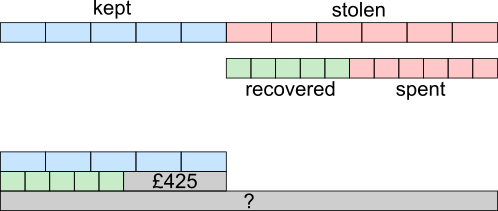
To compare the recovered and kept money, it would be useful if the pieces were the same size.
The 'stolen' money is split into 6 parts by the pensioner, but into 11 parts by the thief. This means that we can split it into 66 pieces.
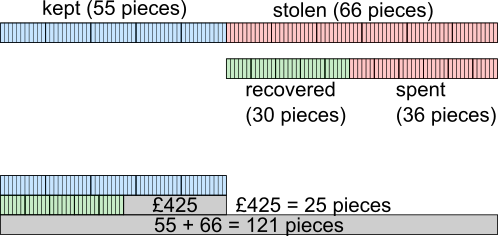
55$-$30 = 25, so £425 is equivalent to 25 pieces.
If 25 pieces are worth £425, then each piece is worth £425$\div$25 = £17.
So 121 pieces are worth 121$\times$ £17 = £2057.

Stolen Pension
Age 14 to 16
ShortChallenge Level 
Answer: £2057
Algebra
Started with $A$
$\frac6{11}A$ stolen, $\frac{5}{11}A$ left
$\swarrow$ $\searrow$
$\frac6{11}$ of $\frac6{11}A$ spent, $\frac5{11}$ of $\frac6{11}A$ recovered
Difference between money left and money recovered is $ £425$ $$\begin{align}
\tfrac5{11}A-\tfrac5{11}\times \tfrac6{11}A&=425\\
\Rightarrow \tfrac5{11}\left(1-\tfrac6{11}\right)A&=425\\
\Rightarrow \tfrac5{11}\times\tfrac5{11}\times A&=425\\
\Rightarrow A &= \tfrac{425}{25}\times121\\
\Rightarrow A&=2057
\end{align}$$
Using a diagram to represent the story
This diagram represents the story.
To compare the recovered and kept money, it would be useful if the pieces were the same size.
The 'stolen' money is split into 6 parts by the pensioner, but into 11 parts by the thief. This means that we can split it into 66 pieces.
55$-$30 = 25, so £425 is equivalent to 25 pieces.
If 25 pieces are worth £425, then each piece is worth £425$\div$25 = £17.
So 121 pieces are worth 121$\times$ £17 = £2057.
You can find more short problems, arranged by curriculum topic, in our short problems collection.
You may also like
2-digit Square
A 2-Digit number is squared. When this 2-digit number is reversed and squared, the difference between the squares is also a square. What is the 2-digit number?
Consecutive Squares
The squares of any 8 consecutive numbers can be arranged into two sets of four numbers with the same sum. True of false?
Plus Minus
Can you explain the surprising results Jo found when she calculated the difference between square numbers?