Skip over navigation


Using area
The diagram below shows the square with area 72 cm$^2$ with the diagonal in red. Then 4 copies of the square are stuck together. Notice that the diagonals form another square, which is also shown on its own.
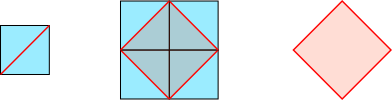
The square formed by the diagonals occupies half of the area of the 4 blue squares, so it has the same area as 2 blue squares, which is 72 + 72 = 144 cm$^2$.
So a square with side length equal to the red diagonal has area 144 cm$^2$, which means the diagonal must be 12 cm, since 12 $\times$ 12 = 144.
Using Pythagoras' Theorem
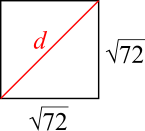
The area of the square is $72$ cm$^2$, so theside length is $\sqrt{72}$. This is shown on the diagram below, which also shows the diagonal, marked $d$.
Applying Pythagoras' Theorem gives $$\begin{align}\sqrt{72}^2+\sqrt{72}^2&=d^2\\
\Rightarrow 72+72&=d^2\\
\Rightarrow 144&=d^2\\
\Rightarrow 12&=d\end{align}$$ (since $d$ must be positive).


Diagonal Area
Age 14 to 16
ShortChallenge Level 

Using area
The diagram below shows the square with area 72 cm$^2$ with the diagonal in red. Then 4 copies of the square are stuck together. Notice that the diagonals form another square, which is also shown on its own.
The square formed by the diagonals occupies half of the area of the 4 blue squares, so it has the same area as 2 blue squares, which is 72 + 72 = 144 cm$^2$.
So a square with side length equal to the red diagonal has area 144 cm$^2$, which means the diagonal must be 12 cm, since 12 $\times$ 12 = 144.
Using Pythagoras' Theorem
The area of the square is $72$ cm$^2$, so theside length is $\sqrt{72}$. This is shown on the diagram below, which also shows the diagonal, marked $d$.
Applying Pythagoras' Theorem gives $$\begin{align}\sqrt{72}^2+\sqrt{72}^2&=d^2\\
\Rightarrow 72+72&=d^2\\
\Rightarrow 144&=d^2\\
\Rightarrow 12&=d\end{align}$$ (since $d$ must be positive).
You can find more short problems, arranged by curriculum topic, in our short problems collection.
You may also like

Ladder and Cube
A 1 metre cube has one face on the ground and one face against a wall. A 4 metre ladder leans against the wall and just touches the cube. How high is the top of the ladder above the ground?
Bendy Quad
Four rods are hinged at their ends to form a convex quadrilateral. Investigate the different shapes that the quadrilateral can take. Be patient this problem may be slow to load.