Skip over navigation


Answer: 8 minutes
Using similar triangles
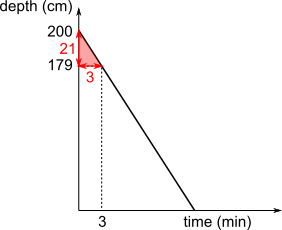
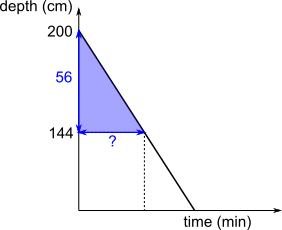
Triangles are similar so 21 : 3 = 56 : ?
21 : 3 = 7 : 1
56 = 7$\times$8 so 56 : 8 is also the same as 7 : 1, ? = 8.
Using rates of change
In the first 3 minutes, the depth of the water decreases by 21 cm.
So in each 1 minute, depth decreases by 7 cm.
To reach 144 cm, it must decrease by 35 cm more, since 144 + 35 = 179.
35 = 7$\times$5, so it will take 5 more minutes, or 8 minutes in total.
Using gradients
In $3$ minutes, the depth of the water goes down by $21$ cm.
So the gradient of the line is $\frac{-21}3=-7$.
When the water level is $144$ cm, the depth of the water will have gone down by $56$ cm.
So, if this happens at time $t$, $\frac{-56}t=-7$, so $t=8$.
Using proportion
Total 8 minutes.
Using congruent triangles
Because the graph is a straight line, we can use congruent triangles congruent to find other points on the graph, as shown on the right.
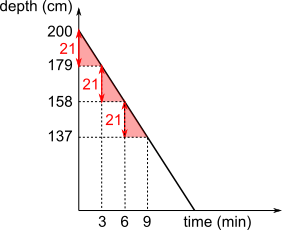
These three triangles have taken us too far, so we can now use smaller similar triangles to find more information:
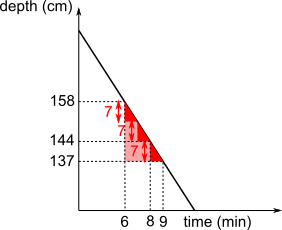 We can see that after 8 minutes, the height of the water will be 144 cm.

Draining a Pool
Age 11 to 14
ShortChallenge Level 

Answer: 8 minutes
Using similar triangles
Triangles are similar so 21 : 3 = 56 : ?
21 : 3 = 7 : 1
56 = 7$\times$8 so 56 : 8 is also the same as 7 : 1, ? = 8.
Using rates of change
In the first 3 minutes, the depth of the water decreases by 21 cm.
So in each 1 minute, depth decreases by 7 cm.
To reach 144 cm, it must decrease by 35 cm more, since 144 + 35 = 179.
35 = 7$\times$5, so it will take 5 more minutes, or 8 minutes in total.
Using gradients
In $3$ minutes, the depth of the water goes down by $21$ cm.So the gradient of the line is $\frac{-21}3=-7$.
When the water level is $144$ cm, the depth of the water will have gone down by $56$ cm.
So, if this happens at time $t$, $\frac{-56}t=-7$, so $t=8$.
Using proportion
| time | decrease | final depth |
|---|---|---|
| 3 minutes | 21 cm | 179 cm |
| 3 more min | 21 cm | 158 cm |
| 1 more min | 7 cm | 151 cm |
| 1 more min | 7 cm | 144 cm |
Total 8 minutes.
Using congruent triangles
Because the graph is a straight line, we can use congruent triangles congruent to find other points on the graph, as shown on the right.
These three triangles have taken us too far, so we can now use smaller similar triangles to find more information:
We can see that after 8 minutes, the height of the water will be 144 cm.You can find more short problems, arranged by curriculum topic, in our short problems collection.
You may also like
Off the Cuff
Can you work out the ratio of shirt types made by a factory, if you know the ratio of button types used?
Out of Sync
Albert Einstein could see two clocks which were out of sync. For what fraction of the day did they show the same time?