Skip over navigation


Here we continue to explore some ideas which arose in a discussion between some school students on the askNRICH webboard. They wanted to know how the definitions and methods of calculus change if you integrate or differentiate $n$ times when $n$ is not a whole number. If you have not read it you may like to start with Fractional Calculus I .
Given a function $f(x)$ defined when $x> 0$, we can form the indefinite integral of $f$ from $0$ to $x$, and we call this $(If)(x)$; thus $$(If)(x) = \int_0^x f(t)\, dt.$$ If we repeat this process we get the 'second integral' $$(I^2f)(x) = \int_0^x (If)(t)\, dt = \int_0^x\left(\int_0^tf(s)\,ds\right)\, dt,$$ and another integration gives the 'third integral' $$(I^3f)(x)= \int_0^x\left[\int_0^t \left(\int_0^s f(u)\,du\right)\, ds \right]\,dt. \quad (2.1)$$ This looks very complicated (and the formula for the $n$-th integral looks even more complicated), so it is a good idea to look at some simple cases. "
Suppose that $f(x)=x^k$, where $x> 0$ and $k$ is an integer. Then $$(If)(x) = {x^{k+1}\over k+1}, \quad (I^2f)(x) = {x^{k+2}\over (k+1)(k+2)},$$ and, more generally, $$(I^nf)(x) = {k!\over (n+k)!}x^{n+k} = {\Gamma(k+1)\over \Gamma(n+k+1)}x^{n+k}. \quad (2.2)$$ Suppose now that $k$ is not a positive integer. Then we still have $$ (I^nf)(x) = {1\over (k+1)(k+2)\cdots (n+k)}x^{n+k} =
{\Gamma(k+1)\over \Gamma(n+k+1)}x^{n+k}.$$ We have now shown that (2.2) holds whenever $n$ is a positive integer. "
It was Cauchy who showed us how we can look at integrals such as (2.1) in a simpler way, and he showed how we can reduce the $n$ repeated integrals in (2.1) to just one integral. To be precise, he showed that $$(I^nf)(x) = {1\over (n-1)\,!}\int_0^x (x-t)^{n-1}f(t)\, dt. \quad (2.3) $$ There is nothing to prove here when $n=1$ because with $n=1$, (2.3) becomes $$(If)(x) = {1\over 0\,!}\int_0^x (x-t)^{0}f(t)\, dt$$ which is just the definition of $(If)(x)$. We shall now prove (2.3) when $n=2$. Let $$g(x) = \int_0^x(x-t)f(t)\, dt\ ; \quad (2.4) $$ this is the right handside of (2.3) when $n=2$ so we want to show that $g(x) = (I^2f)(x)$. Observe that $$g(x) = x\int_0^x f(t)\,dt - \int_0^x tf(t)\, dt, \quad (2.5)$$ and if we differentiate both sides of this equation with respect to $x$ (and use the product formula for the first term) we get $$g'(x) = \left[\int_0^x f(t)\,dt +xf(x)\right]- xf(x) = \int_0^x f(t)\,dt = (If)(x).$$ Now (2.4) implies that $g(0)=0$, so we now have $$g(x)=g(x)-g(0)=\int_0^x g'(t)\,dt = \int_0^x(If)(t)\,dt =(I^2f)(x)$$ as required. The proof for a general $n$ is similar. We expand the term $(x-t)^{n-1}$ by the Binomial Theorem, and then write $g(x)$ in the manner of (2.5) with all the terms $x^j$ outside the integral sign. The argument then goes as before, and we shall now assume that (2.3) is true for every positive integer $n$. "
The question now is what is $(I^\alpha f)(x)$ when $\alpha$ is any positive number? Following exactly the same idea that we used for the factorial function, we now use Cauchy's formula (2.3) as the basis for our definition of $(I^\alpha f)(x)$. In fact, for every positive $\alpha$ we DEFINE $$(I^\alpha f)(x) = {1\over \Gamma(\alpha)} \int_0^x (x-t)^{\alpha -1}f(t)\, dt.$$ We recall from the previous article that if $\alpha$ is a positive integer, then $\Gamma(\alpha) = (\alpha -1)!$ so this definition of $(I^\alpha f)(x)$ agrees with (2.3) when $\alpha$ is a positive integer. "
Let us now see what $(I^a f)(x)$ is when $f(x) = x^k$ and $a$ is any positive number. Our definition implies that $$(I^a f)(x) = {1\over \Gamma(a)}\int_0^x(x-t)^{a-1}t^k\,dt,$$ and if we now make the substitution $u=t/x$, we obtain $$(I^a f)(x) = {x^{a+k}\over \Gamma(a)} \int_0^1 u^k(1-u)^{a-1}\,du.$$ We now have another problem, for there is no simple way to evaluate this definite integral. In fact, many people have studied this integral at great length and, rather remarkably, it turns out to be very closely related to the Gamma function. In fact, if we write $${\rm B}(x,y) = \int_0^1 t^{x-1}(1-t)^{y-1}\, dt$$ (this is called the Beta function), where $x$ and $y$ are positive, then we get $${\rm B}(x,y) = {\Gamma(x)\Gamma(y)\over \Gamma (x+y)}.$$
Using this, we now see that $$(I^a f)(x) = {x^{a+k}\over \Gamma(a)} B(k+1,a) = {x^{a+k}\over\Gamma(a)} \left({\Gamma(k+1)\Gamma(a)\over\Gamma (a+k+1)}\right) ={\Gamma(k+1)\over \Gamma (a+k+1)}x^{a+k},$$ which agrees with (2.2) in the case when $a$ is an integer. In conclusion, we have now shown that if $f(x)=x^k$, and if $x> 0$ and $a> 0$, then $$(I^a f)(x) = {\Gamma(k+1)\over \Gamma (a+k+1)}x^{a+k}.$$
Example 1 Let us evaluate $(I^{1/2}f)(x)$ when $f(x)= \sqrt{x} = x^{1/2}$. According to the formula, we have $$(I^{1/2}f)(x) = {\Gamma(3/2)\over \Gamma(2)}x = \Gamma(3/2)x ={1\over 2}\Gamma(1/2)x = {\sqrt{\pi}\over 2}x.$$
Example 2 Show that with $f(x)=x^2$, $$(I^{3/2}f)(x) = {32\over 105\sqrt{\pi}}\,x^{7/2}.$$ "
Suppose that $f(x) = x^k$, and that $a$ and $b$ are positive. Then $$(I^b f)(x) = {\Gamma(k+1)\over \Gamma (b+k+1)}x^{b+k} =Ag(x),$$ say, where $g(x) = x^{b+k}$. This gives $$I^a\big(I^bf\big)(x) = A\times (I^ag)(x) = {\Gamma(k+1)\over \Gamma (b+k+1)}\times {\Gamma(b+k+1)\over \Gamma (a+b+k+1)}x^{a+b+k} = (I^{a+b}f)(x).$$ We have now shown that if $f$ is any power of $x$, then $$\big(I^a(I^bf)\big)(x) = (I^{a+b}f)(x) = \big(I^b(I^af)\big)(x).$$ In fact, this holds for all functions $f$ but this is not easy to prove. Indeed, we shall show in the next article that the corresponding result does NOT hold for fractional derivatives.
Fractional Calculus II
Introduction to the second article
Here we continue to explore some ideas which arose in a discussion between some school students on the askNRICH webboard. They wanted to know how the definitions and methods of calculus change if you integrate or differentiate $n$ times when $n$ is not a whole number. If you have not read it you may like to start with Fractional Calculus I .
Repeated integrals
Given a function $f(x)$ defined when $x> 0$, we can form the indefinite integral of $f$ from $0$ to $x$, and we call this $(If)(x)$; thus $$(If)(x) = \int_0^x f(t)\, dt.$$ If we repeat this process we get the 'second integral' $$(I^2f)(x) = \int_0^x (If)(t)\, dt = \int_0^x\left(\int_0^tf(s)\,ds\right)\, dt,$$ and another integration gives the 'third integral' $$(I^3f)(x)= \int_0^x\left[\int_0^t \left(\int_0^s f(u)\,du\right)\, ds \right]\,dt. \quad (2.1)$$ This looks very complicated (and the formula for the $n$-th integral looks even more complicated), so it is a good idea to look at some simple cases. "
Example : the functions $x^k$
Cauchy's result
It was Cauchy who showed us how we can look at integrals such as (2.1) in a simpler way, and he showed how we can reduce the $n$ repeated integrals in (2.1) to just one integral. To be precise, he showed that $$(I^nf)(x) = {1\over (n-1)\,!}\int_0^x (x-t)^{n-1}f(t)\, dt. \quad (2.3) $$ There is nothing to prove here when $n=1$ because with $n=1$, (2.3) becomes $$(If)(x) = {1\over 0\,!}\int_0^x (x-t)^{0}f(t)\, dt$$ which is just the definition of $(If)(x)$. We shall now prove (2.3) when $n=2$. Let $$g(x) = \int_0^x(x-t)f(t)\, dt\ ; \quad (2.4) $$ this is the right handside of (2.3) when $n=2$ so we want to show that $g(x) = (I^2f)(x)$. Observe that $$g(x) = x\int_0^x f(t)\,dt - \int_0^x tf(t)\, dt, \quad (2.5)$$ and if we differentiate both sides of this equation with respect to $x$ (and use the product formula for the first term) we get $$g'(x) = \left[\int_0^x f(t)\,dt +xf(x)\right]- xf(x) = \int_0^x f(t)\,dt = (If)(x).$$ Now (2.4) implies that $g(0)=0$, so we now have $$g(x)=g(x)-g(0)=\int_0^x g'(t)\,dt = \int_0^x(If)(t)\,dt =(I^2f)(x)$$ as required. The proof for a general $n$ is similar. We expand the term $(x-t)^{n-1}$ by the Binomial Theorem, and then write $g(x)$ in the manner of (2.5) with all the terms $x^j$ outside the integral sign. The argument then goes as before, and we shall now assume that (2.3) is true for every positive integer $n$. "
Fractional integrals
The question now is what is $(I^\alpha f)(x)$ when $\alpha$ is any positive number? Following exactly the same idea that we used for the factorial function, we now use Cauchy's formula (2.3) as the basis for our definition of $(I^\alpha f)(x)$. In fact, for every positive $\alpha$ we DEFINE $$(I^\alpha f)(x) = {1\over \Gamma(\alpha)} \int_0^x (x-t)^{\alpha -1}f(t)\, dt.$$ We recall from the previous article that if $\alpha$ is a positive integer, then $\Gamma(\alpha) = (\alpha -1)!$ so this definition of $(I^\alpha f)(x)$ agrees with (2.3) when $\alpha$ is a positive integer. "
Example : the functions $x^k$ again
Let us now see what $(I^a f)(x)$ is when $f(x) = x^k$ and $a$ is any positive number. Our definition implies that $$(I^a f)(x) = {1\over \Gamma(a)}\int_0^x(x-t)^{a-1}t^k\,dt,$$ and if we now make the substitution $u=t/x$, we obtain $$(I^a f)(x) = {x^{a+k}\over \Gamma(a)} \int_0^1 u^k(1-u)^{a-1}\,du.$$ We now have another problem, for there is no simple way to evaluate this definite integral. In fact, many people have studied this integral at great length and, rather remarkably, it turns out to be very closely related to the Gamma function. In fact, if we write $${\rm B}(x,y) = \int_0^1 t^{x-1}(1-t)^{y-1}\, dt$$ (this is called the Beta function), where $x$ and $y$ are positive, then we get $${\rm B}(x,y) = {\Gamma(x)\Gamma(y)\over \Gamma (x+y)}.$$
Using this, we now see that $$(I^a f)(x) = {x^{a+k}\over \Gamma(a)} B(k+1,a) = {x^{a+k}\over\Gamma(a)} \left({\Gamma(k+1)\Gamma(a)\over\Gamma (a+k+1)}\right) ={\Gamma(k+1)\over \Gamma (a+k+1)}x^{a+k},$$ which agrees with (2.2) in the case when $a$ is an integer. In conclusion, we have now shown that if $f(x)=x^k$, and if $x> 0$ and $a> 0$, then $$(I^a f)(x) = {\Gamma(k+1)\over \Gamma (a+k+1)}x^{a+k}.$$
Example 1 Let us evaluate $(I^{1/2}f)(x)$ when $f(x)= \sqrt{x} = x^{1/2}$. According to the formula, we have $$(I^{1/2}f)(x) = {\Gamma(3/2)\over \Gamma(2)}x = \Gamma(3/2)x ={1\over 2}\Gamma(1/2)x = {\sqrt{\pi}\over 2}x.$$
Example 2 Show that with $f(x)=x^2$, $$(I^{3/2}f)(x) = {32\over 105\sqrt{\pi}}\,x^{7/2}.$$ "
Repeated integration again
Suppose that $f(x) = x^k$, and that $a$ and $b$ are positive. Then $$(I^b f)(x) = {\Gamma(k+1)\over \Gamma (b+k+1)}x^{b+k} =Ag(x),$$ say, where $g(x) = x^{b+k}$. This gives $$I^a\big(I^bf\big)(x) = A\times (I^ag)(x) = {\Gamma(k+1)\over \Gamma (b+k+1)}\times {\Gamma(b+k+1)\over \Gamma (a+b+k+1)}x^{a+b+k} = (I^{a+b}f)(x).$$ We have now shown that if $f$ is any power of $x$, then $$\big(I^a(I^bf)\big)(x) = (I^{a+b}f)(x) = \big(I^b(I^af)\big)(x).$$ In fact, this holds for all functions $f$ but this is not easy to prove. Indeed, we shall show in the next article that the corresponding result does NOT hold for fractional derivatives.
The next article in the series .
The previous article .
Related Collections
You may also like
2D-3D
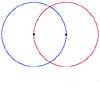
Two circles of equal size intersect and the centre of each circle is on the circumference of the other. What is the area of the intersection? Now imagine that the diagram represents two spheres of equal volume with the centre of each sphere on the surface of the other. What is the volume of intersection?
Power Up
Show without recourse to any calculating aid that 7^{1/2} + 7^{1/3} + 7^{1/4} < 7 and 4^{1/2} + 4^{1/3} + 4^{1/4} > 4 . Sketch the graph of f(x) = x^{1/2} + x^{1/3} + x^{1/4} -x
Fractional Calculus I
You can differentiate and integrate n times but what if n is not a whole number? This generalisation of calculus was introduced and discussed on askNRICH by some school students.