Skip over navigation
Cambridge University Faculty of Mathematics NRich logo
menu search
  • Teachers expand_more
    • Early years
    • Primary
    • Secondary
    • Post-16
    • Events
    • Professional development
  • Students expand_more
    • Primary
    • Secondary
    • Post-16
  • Parents expand_more
    • Early Years
    • Primary
    • Secondary
    • Post-16
  • Problem-Solving Schools
  • About NRICH expand_more
    • About us
    • Impact stories
    • Support us
    • Our funders
    • Contact us
  • search

Or search by topic

Number and algebra

  • The Number System and Place Value
  • Calculations and Numerical Methods
  • Fractions, Decimals, Percentages, Ratio and Proportion
  • Properties of Numbers
  • Patterns, Sequences and Structure
  • Algebraic expressions, equations and formulae
  • Coordinates, Functions and Graphs

Geometry and measure

  • Angles, Polygons, and Geometrical Proof
  • 3D Geometry, Shape and Space
  • Measuring and calculating with units
  • Transformations and constructions
  • Pythagoras and Trigonometry
  • Vectors and Matrices

Probability and statistics

  • Handling, Processing and Representing Data
  • Probability

Working mathematically

  • Thinking mathematically
  • Developing positive attitudes
  • Cross-curricular contexts

Advanced mathematics

  • Decision Mathematics and Combinatorics
  • Advanced Probability and Statistics
  • Mechanics
  • Calculus

For younger learners

  • Early Years Foundation Stage

Partly Painted Cube Poster

Age 11 to 14
Challenge Level Yellow star
  • Problem
  • Student Solutions

Answer: It was a 5 by 5 by 5 cube with four faces painted and two opposite faces unpainted


Working backwards from the result

45 = 3$\times$3$\times$5

It must have been a 5 by 5 by 5 cube because the longest side is 5 cubes long. We can't add any more painted cubes to that side.
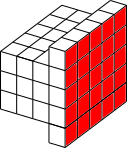
Need to add a face to each side of the 3 by 3 face $\therefore$ we will add 4 faces like this


Painting cube faces

43 = 64 $\gt$ 45

53 = 125 $\gt$ 45

63 - even if you painted all of the faces, there would be 43 = 64 unpainted cubes in the middle. So it must be 43 or 53

64, each face 16. Paint one face, 48 cubes unpainted. There is no way to paint just 3 cubes.

125, each face 25. Paint one face, 100 left unpainted, 5 by 5 by 4 
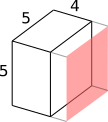
Painting the opposite face would leave 75 unpainted (remove a 5 by 5 face)
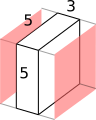
 

Painting any other face would leave 80 left unpainted (remove a 5 by 4 face) 
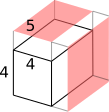
Paint opposite face: 5 by 5 by 3. You can't paint 25 again because no side can be shorter than 3. Paint 15 cubes to leave 60 unpainted, 5 by 4 by 3
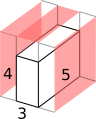
Then painting the bottom face will remove another 15 cubes, leaving 45 unpainted.

Related Collections

  • More Posters
  • Secondary Posters

You may also like

Arithmagons Poster

Arithmagons Poster

Squares in Rectangles Poster

Squares In Rectangles Poster

Isosceles Triangles Poster

Isosceles Triangles Poster - February 2005

  • Tech help
  • Accessibility Statement
  • Sign up to our newsletter
  • Twitter X logo

The NRICH Project aims to enrich the mathematical experiences of all learners. To support this aim, members of the NRICH team work in a wide range of capacities, including providing professional development for teachers wishing to embed rich mathematical tasks into everyday classroom practice.

NRICH is part of the family of activities in the Millennium Mathematics Project.

University of Cambridge logo NRICH logo