Birthday Sharing


Birthday Sharing
It's Sahila's birthday and she is having a party.
Show us how you could answer these questions using:
- words
- pictures
- numbers
- objects
- other ways...

Sahila has 18 cupcakes for the party tea and she would like to share them out equally onto two plates for the table.
How many cakes will go on each plate?

Sahila has invited nine children to her party.
They are going to play a game in pairs. Each pair will need a balloon.
How many balloons will they need?
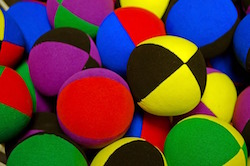
Sahila is going to give everyone five juggling balls to take home after the party.
Will 55 balls be enough?
Why do this problem?
At first glance this looks like any collection of word problems about division. However each different scenario draws attention to a different way of thinking about the idea of division:- sharing, grouping
- successive subtraction
- or the inverse of multiplication.
An article which explores different ways of thinking about division can be found here.
Children will be curious that there are different ways to represent their thinking, and discussing their different ways of working will offer insights and deepend their understanding of division.
Possible approach
In each case it would be possible to use a range of representations of the situation to help solve the problem and children should be encouraged to explain how they have tackled the problem and arrived at their solution using different resources to help them. Look and listen carefully to hear how they make sense of the question and develop a strategy for solving it. This may be somewhat different from the 'taught' approach. Given the opportunity, children often have their own ways of working.Talk to the children about how different people do things in different ways and explain that this actvity is all about that - it's important that the children don't presume that there is one way and one way only to see the calculation.
Working within a pair or small group and tackling one problem at a time can help children to focus more deeply on one task rather than racing through them. You could suggest that they think and talk about what they are going to do before they actually begin.
They may decide to enact with objects or make a picture and just record the answer. Or use these as a prompt to transfer the problem to a calculation which they would record horizontally. Whichever, your observations will allow you to reflect on the children's confidence, language and understanding and possibly what misconceptions they hold.
Key questions
Tell me how you are working this out.What do you think of _____'s way of doing this?
How did you know what to do first?
Is the way you've done this one different from the way you have done the others?
Possible extension
Ask the pupils to create stories that involve calculations for their partners to do.Give the pupils a written form of a division question eg $18 \div ? = 3$ and challenge them to create a story around it.
Ask the children to create their own division problems based on stories about sharing, grouping, 'undoing' multiplication or successive subtraction. Additional links to other division problems can be found in this article.
Possible support
Some pupils will benefit from working with some small toys/dolls so that they can enact the situation before being able to think about the calculation, for example the children could use Lego figures to show the children at the party and counters for the cakes with circles of paper as plates. The physical act of moving objects in different ways while enacting the story can often help less confident children to work out how to think about the division in an appropriate way that makes sense to them.You may also like
Month Mania
Can you design a new shape for the twenty-eight squares and arrange the numbers in a logical way? What patterns do you notice?
Starfish Spotting
How many starfish could there be on the beach, and how many children, if I can see 28 arms?