Skip over navigation





Looking at Lego
Age 7 to 11
Challenge Level 

We had just a few solutions sent in for this activity, but they were excellent, thank you.
Lauren and Violet from Westridge Private School in the USA wrote: Ӭ
First, we counted the legos and the rows added up to 12 and 12 on the first picture, 24 and 24 on the second, and 72 on the third.
12 + 12 = 24. 24 + 24 = 48. 48 + 24 = 216. 216 $\div$ 3 = 72!
Melanie from St Adrians RC Primary School sent in the following:Ӭ
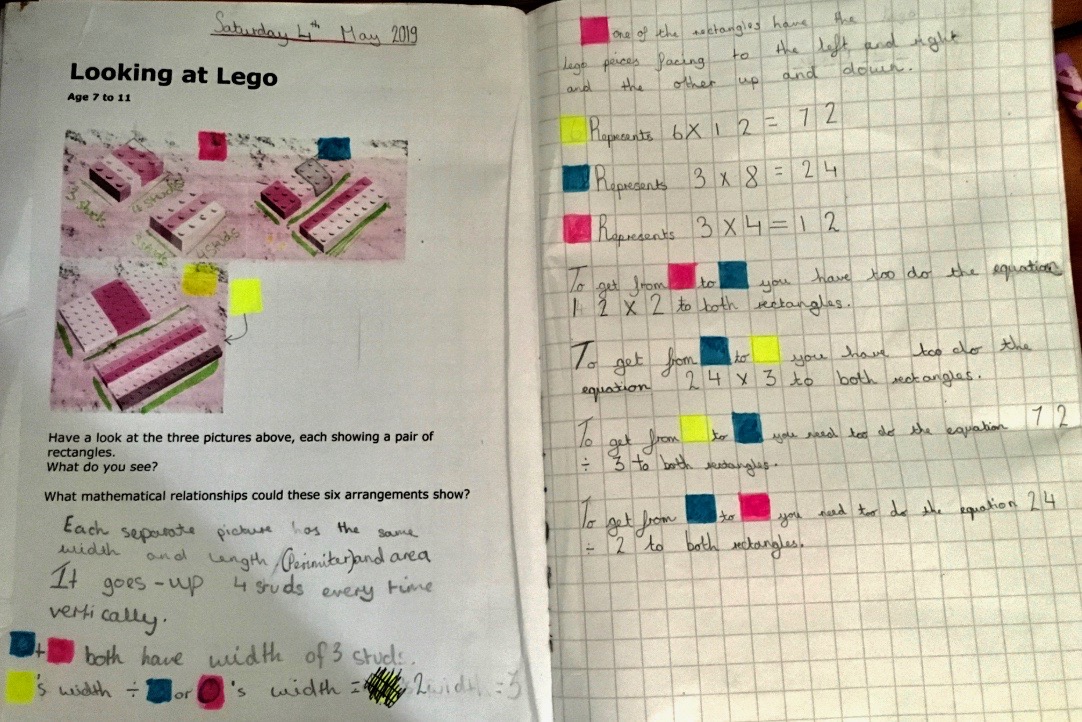
I started off by colour-coding the squares so it is much easier to know which one I'm talking about. The first thing I noticed was that the two rectangles in each picture had the same perimeter and area. Then I realised that in each picture the squares high was ascending by four studs vertically. Then I saw that to get from the first picture to the second one you had to do the equation 12 × 2 to both of the rectangles but to get from the second one to the third one you had to do the equation 24 × 3. Then for the division to get from the third picture to the second picture you had to do the calculation 72 ÷ 3 and to get from the second one to the first one you had to do 24 ÷ 2.
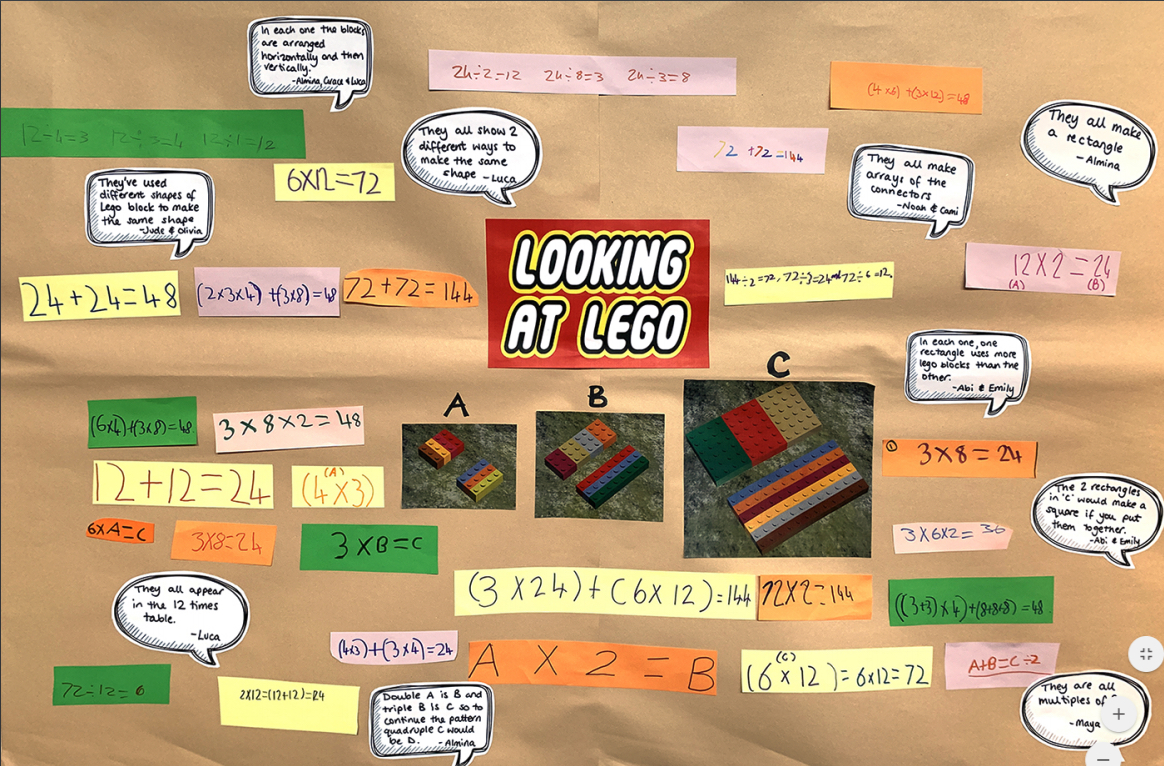
Children from St Monans Primary School in Scotland wrote the following (a larger version of their poster can be see by clicking on the picture:
As a class we did some maths talk around what we could see and our teacher jotted down some of our observations. We then worked in pairs to come up with as many different number sentences to describe some of the relationships we could see in the pictures. We decided to call the bumps on the lego "connectors".
We also labelled the pictures A, B and C so that we could even describe the relationships between the different pictures.
Finally we brought all our results together and explained our ideas to each other. We created a large display of all our results too with speech bubbles for our initial observations.
Maybe you could create another set of three pictures made from Lego rectangles of different sizes and explore further?
Lauren and Violet from Westridge Private School in the USA wrote: Ӭ
First, we counted the legos and the rows added up to 12 and 12 on the first picture, 24 and 24 on the second, and 72 on the third.
12 + 12 = 24. 24 + 24 = 48. 48 + 24 = 216. 216 $\div$ 3 = 72!
Melanie from St Adrians RC Primary School sent in the following:Ӭ
I started off by colour-coding the squares so it is much easier to know which one I'm talking about. The first thing I noticed was that the two rectangles in each picture had the same perimeter and area. Then I realised that in each picture the squares high was ascending by four studs vertically. Then I saw that to get from the first picture to the second one you had to do the equation 12 × 2 to both of the rectangles but to get from the second one to the third one you had to do the equation 24 × 3. Then for the division to get from the third picture to the second picture you had to do the calculation 72 ÷ 3 and to get from the second one to the first one you had to do 24 ÷ 2.
Children from St Monans Primary School in Scotland wrote the following (a larger version of their poster can be see by clicking on the picture:
As a class we did some maths talk around what we could see and our teacher jotted down some of our observations. We then worked in pairs to come up with as many different number sentences to describe some of the relationships we could see in the pictures. We decided to call the bumps on the lego "connectors".
We also labelled the pictures A, B and C so that we could even describe the relationships between the different pictures.
Finally we brought all our results together and explained our ideas to each other. We created a large display of all our results too with speech bubbles for our initial observations.
Maybe you could create another set of three pictures made from Lego rectangles of different sizes and explore further?
You may also like
Exploring Wild & Wonderful Number Patterns
EWWNP means Exploring Wild and Wonderful Number Patterns Created by Yourself! Investigate what happens if we create number patterns using some simple rules.
Sending Cards
This challenge asks you to investigate the total number of cards that would be sent if four children send one to all three others. How many would be sent if there were five children? Six?
Dice and Spinner Numbers
If you had any number of ordinary dice, what are the possible ways of making their totals 6? What would the product of the dice be each time?