Skip over navigation
Cambridge University Faculty of Mathematics NRich logo
menu search
  • Teachers expand_more
    • Early years
    • Primary
    • Secondary
    • Post-16
    • Events
    • Professional development
  • Students expand_more
    • Primary
    • Secondary
    • Post-16
  • Parents expand_more
    • Early Years
    • Primary
    • Secondary
    • Post-16
  • Problem-Solving Schools
  • About NRICH expand_more
    • About us
    • Impact stories
    • Support us
    • Our funders
    • Contact us
  • search

Or search by topic

Number and algebra

  • The Number System and Place Value
  • Calculations and Numerical Methods
  • Fractions, Decimals, Percentages, Ratio and Proportion
  • Properties of Numbers
  • Patterns, Sequences and Structure
  • Algebraic expressions, equations and formulae
  • Coordinates, Functions and Graphs

Geometry and measure

  • Angles, Polygons, and Geometrical Proof
  • 3D Geometry, Shape and Space
  • Measuring and calculating with units
  • Transformations and constructions
  • Pythagoras and Trigonometry
  • Vectors and Matrices

Probability and statistics

  • Handling, Processing and Representing Data
  • Probability

Working mathematically

  • Thinking mathematically
  • Developing positive attitudes
  • Cross-curricular contexts

Advanced mathematics

  • Decision Mathematics and Combinatorics
  • Advanced Probability and Statistics
  • Mechanics
  • Calculus

For younger learners

  • Early Years Foundation Stage

A Numbered Route

Age 7 to 11
Challenge Level Yellow starYellow star
  • Problem
  • Getting Started
  • Student Solutions
  • Teachers' Resources

A Numbered Route

Can you draw a continuous line through $16$ numbers on this grid so that the total of the numbers you pass through is as high as possible?
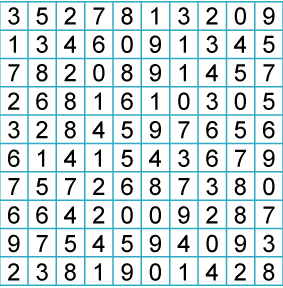
You may start and finish where you like, and go horizontally, vertically or diagonally but you may only pass through a number once and the line must not cross itself at any point.

If you repeat this but only go horizontally and vertically and never go diagonally, what is the highest score then?


Why do this problem?

This problem provides a strategic and very visible context in which learners can practise addition and subtraction. They will have to work systematically using trial and improvement, and they will need to look ahead to see where their route is going. Finding a route which gives a high score is not very difficult, but finding one that gives the highest possible score with sixteen numbers is challenging.

Possible approach

You could start with the whole group with the grid given or a different one as an illustration of the task. Learners should realise that there are two parts to the problem, the first where diagonal moves are allowed and the second where these must not be used.

When everyone is clear about what they have to do they could set to work in pairs on the problem so that they are able to talk through their ideas with a partner. It would be a good opportunity for you to listen to how learners are tackling the problem and what strategies they are using. There are two copies of the grid on this sheet. They will probably need plenty of these!

At the end of the lesson there should be a good discussion on techniques used to find the most high-scoring routes. What were the differences found when using and not using diagonal moves? Was it difficult to stick to the sixteen numbers? Was it easy to visualise the route, to see where to go next?

Key questions

Where would be a good place on the grid to start?
Can you see where to go next?
Which numbers are you aiming for?
Have you checked that you have used exactly sixteen numbers?
Have you re-checked your adding?

Possible extension

Learners could find other routes such as the one which gives the lowest score when they are quite certain they have found the one with the highest score. Alternatively they could make their own grid for others to try.

Possible support

Suggest using a calculator to add the numbers on the route when it has been drawn out. There are two copies of the grid on this sheet.
 

You may also like

Worms

Place this "worm" on the 100 square and find the total of the four squares it covers. Keeping its head in the same place, what other totals can you make?
Which Scripts?

There are six numbers written in five different scripts. Can you sort out which is which?
Highest and Lowest

Put operations signs between the numbers 3 4 5 6 to make the highest possible number and lowest possible number.

  • Tech help
  • Accessibility Statement
  • Sign up to our newsletter
  • Twitter X logo

The NRICH Project aims to enrich the mathematical experiences of all learners. To support this aim, members of the NRICH team work in a wide range of capacities, including providing professional development for teachers wishing to embed rich mathematical tasks into everyday classroom practice.

NRICH is part of the family of activities in the Millennium Mathematics Project.

University of Cambridge logo NRICH logo