Skip over navigation

Cambridge University Faculty of Mathematics NRich logo
menu search
  • Teachers expand_more
    • Early years
    • Primary
    • Secondary
    • Post-16
    • Events
    • Professional development
  • Students expand_more
    • Primary
    • Secondary
    • Post-16
  • Parents expand_more
    • Early Years
    • Primary
    • Secondary
    • Post-16
  • Problem-Solving Schools
  • About NRICH expand_more
    • About us
    • Impact stories
    • Support us
    • Our funders
    • Contact us
  • search

Or search by topic

Number and algebra

  • The Number System and Place Value
  • Calculations and Numerical Methods
  • Fractions, Decimals, Percentages, Ratio and Proportion
  • Properties of Numbers
  • Patterns, Sequences and Structure
  • Algebraic expressions, equations and formulae
  • Coordinates, Functions and Graphs

Geometry and measure

  • Angles, Polygons, and Geometrical Proof
  • 3D Geometry, Shape and Space
  • Measuring and calculating with units
  • Transformations and constructions
  • Pythagoras and Trigonometry
  • Vectors and Matrices

Probability and statistics

  • Handling, Processing and Representing Data
  • Probability

Working mathematically

  • Thinking mathematically
  • Developing positive attitudes
  • Cross-curricular contexts

Advanced mathematics

  • Decision Mathematics and Combinatorics
  • Advanced Probability and Statistics
  • Mechanics
  • Calculus

For younger learners

  • Early Years Foundation Stage

Right or Left?

Age 7 to 11
Challenge Level Yellow starYellow star
  • Problem
  • Getting Started
  • Student Solutions
  • Teachers' Resources

Right or Left?


You may know that opposite faces of a dice add up to $7$, but did you know that there are two different types of dice?
Here are two dice, a right-handed one and a left-handed one:
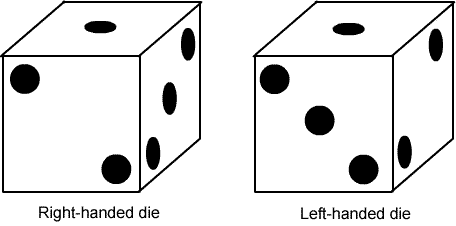
right-handed and left-handed dice

Decide whether the dice below are right-handed or left-handed:
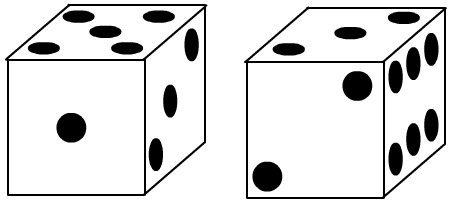
die with 5 on top face, 1 on near face, 3 on right face. Die with 3 on top face, 2 on near face and 6 on fight face


Now try these - they are more difficult.
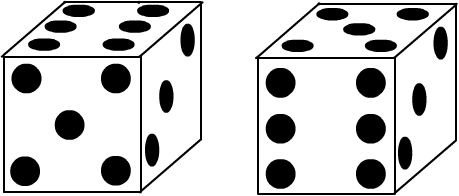
 

Die with 6 on top face, 5 on near face and 3 on right face. Die with five on top face, 6 on near face and 3 on right face

This problem is taken from the book "Mathematical Activities from Poland" published by ATM.


Why do this problem?

This problem encourages children to explore dice in more detail.  Even though they may use them frequently, they may not have thought about a dice's properties before.  They will be challenged to visualise the dice but making nets of cubes might also be helpful. 


Key questions

What do opposite sides of the dice add to?
Can you imagine turning the dice so that you can compare it with the pictures of the right-handed and left-handed dice more easily?
If the $1$ is at the top of the dice and the $2$ facing you, where is the $3$ on the right-handed dice/left-handed dice?
Have a look at the dice in our classroom, are they left-handed or right-handed?

Possible support

If learners are having trouble with the visualisation and you don't have left-handed and right-handed dice, they could stick spots onto cubes to help.   Alternatively, print off this sheet which has a net of a right-hand dice on the first page and a net of a left-handed dice on the second.


You may also like
Construct-o-straws

Make a cube out of straws and have a go at this practical challenge.

Matchsticks

Reasoning about the number of matches needed to build squares that share their sides.

Little Boxes

How many different cuboids can you make when you use four CDs or DVDs? How about using five, then six?

  • Tech help
  • Accessibility Statement
  • Sign up to our newsletter
  • Twitter X logo

The NRICH Project aims to enrich the mathematical experiences of all learners. To support this aim, members of the NRICH team work in a wide range of capacities, including providing professional development for teachers wishing to embed rich mathematical tasks into everyday classroom practice.

NRICH is part of the family of activities in the Millennium Mathematics Project.

University of Cambridge logo NRICH logo