Skip over navigation


Often people who don't know how to add fractions do so as if the rule is $${a\over b} + {c\over d} = {a+c\over b+d}$$ where $a$ and $b$ are coprime and $c$ and $d$ are coprime. Does this ever give the right answer?
As Andrei Lazanu from Tudor Vianu National College, Bucharest, Romania says "The only solution for the problem is $a = -c$ and $b = d$ so that the sum $${a\over b} + {c\over d}$$ is zero and $${a+c\over b+d}=0,$$ so the relation is true".
Why is this the only possibility? The relation
$${a\over b} + {c\over d} = {a+c\over b+d}$$ holds if and only if $${ad+bc \over bd} = {a+c \over b+d}$$ that is $$(ad+bc)(b+d) = (a+c)bd$$ which holds if and only if $$ad^2 + b^2c = 0,$$ or equivalently $$ad^2=-b^2c.$$ We know that any whole number can be written as the unique product of prime factors. As $a$ and $b$ are coprime and $c$ and $d$ are coprime $ad^2=-b^2c$ is true only if $a$ divides $c$ and $c$ divides $a$ and they are of opposite sign, that is $a = -c$. Thus the original formula holds if and only if $d = \pm b$ and $b+d \neq 0$ that is $b=d$ so the formula holds if and only if ${a\over b} = {-c\over d}$ and their sum is zero.
Can it Be?
Age 16 to 18
Challenge Level 

Often people who don't know how to add fractions do so as if the rule is $${a\over b} + {c\over d} = {a+c\over b+d}$$ where $a$ and $b$ are coprime and $c$ and $d$ are coprime. Does this ever give the right answer?
As Andrei Lazanu from Tudor Vianu National College, Bucharest, Romania says "The only solution for the problem is $a = -c$ and $b = d$ so that the sum $${a\over b} + {c\over d}$$ is zero and $${a+c\over b+d}=0,$$ so the relation is true".
Why is this the only possibility? The relation
$${a\over b} + {c\over d} = {a+c\over b+d}$$ holds if and only if $${ad+bc \over bd} = {a+c \over b+d}$$ that is $$(ad+bc)(b+d) = (a+c)bd$$ which holds if and only if $$ad^2 + b^2c = 0,$$ or equivalently $$ad^2=-b^2c.$$ We know that any whole number can be written as the unique product of prime factors. As $a$ and $b$ are coprime and $c$ and $d$ are coprime $ad^2=-b^2c$ is true only if $a$ divides $c$ and $c$ divides $a$ and they are of opposite sign, that is $a = -c$. Thus the original formula holds if and only if $d = \pm b$ and $b+d \neq 0$ that is $b=d$ so the formula holds if and only if ${a\over b} = {-c\over d}$ and their sum is zero.
You may also like
There's a Limit
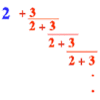
Explore the continued fraction: 2+3/(2+3/(2+3/2+...)) What do you notice when successive terms are taken? What happens to the terms if the fraction goes on indefinitely?
Not Continued Fractions
Which rational numbers cannot be written in the form x + 1/(y + 1/z) where x, y and z are integers?