Skip over navigation


Orange Drink
Age 7 to 11
Challenge Level 

Orange Drink
This is a $750$ ml bottle of concentrated orange squash.
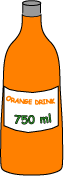
It is enough to make fifteen $250$ ml glasses of diluted orange drink.
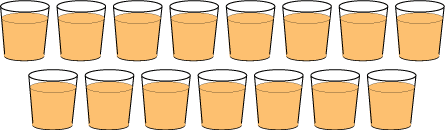
How much water is needed to make $10$ litres of this drink?
Why do this problem?
This question tackles proportion in a real context. It also needs systematic thinking to sort out the information and take a step-by-step route to the solution.Possible approach
You could introduce this problem to learners simply as it stands and then, without saying anything more, give them a few moments to think completely on their own about what they might do. (They might like to jot some ideas down on paper or a mini-whiteboard.) Next, invite children to talk to a partner about a possible approach and suggest that they come to an agreement about how the problem
might be tackled. At this stage, you could ask for some suggestions, or you might want to leave them to begin. However, after some time of working together, it would be good to draw attention to a range of different approaches by asking a few pairs to explain what they are doing. Emphasise that there is not just one way to go about this problem - you are looking for clear descriptions of a
possible start. You could also invite pupils to share different ways of recording or jotting.
In a plenary session you could use this as an opportunity for some children to model a logical approach. In order to reach a solution to this problem, it is a matter of thinking about what we can work out from the information and then using this to answer the question.
Key questions
How much juice is there in each glass of drink?
How much water is there in each glass of drink?
How many glasses of drink are there in a litre? In $10$ litres?
What fraction of the made-up drink is water?
Possible extension
You could extend this problem into a school-based context, for example, if every child in your school had a $250$ ml drink of this drink on sports day, how many $750$ ml bottles of concentrated orange squash would be needed? You might like to encourage some children to look at Mixing Lemonade.
Possible support
Before trying this problem, some children might find it helpful to look at Blackcurrantiest which looks at the concept of proportion.
You may also like

Pies
Grandma found her pie balanced on the scale with two weights and a quarter of a pie. So how heavy was each pie?