Skip over navigation


Daniel, from Wales High School, sent us this very elegant solution:
The formula for the volume of a tetrahedron is $$1/3 \times \text{area of base} \times \text{perpendicular height}$$ If you slice the tetrahedron in half through $b$ you end up with two equal smaller pyramids. I will work out the volume of one and then multiply by $2$ because they have equal volumes. So to start, I must work out the area of the base. The area of a triangle is calculated as follows: $$1/2 \times \text{base} \times \text{perpendicular height}$$ The base is $a$ and the perpendicular height is $b$ so the area of the base is $$(1/2)\times a\times b=(a b/2)$$ So using the formula for the volume of a pyramid: $$\text{Volume}=(1/3) \times (ab/2)\times (a/2)=a^2b/12$$ Times this by $2$ to get the volume for the big tetrahedron: $$(a^2b/12)\times 2=2a^2b/12 =a^2b/6$$ So the volume of the big tetrahedron is $a^2b/6$.
Sliced
Age 14 to 16
Challenge Level 

Daniel, from Wales High School, sent us this very elegant solution:
The formula for the volume of a tetrahedron is $$1/3 \times \text{area of base} \times \text{perpendicular height}$$ If you slice the tetrahedron in half through $b$ you end up with two equal smaller pyramids. I will work out the volume of one and then multiply by $2$ because they have equal volumes. So to start, I must work out the area of the base. The area of a triangle is calculated as follows: $$1/2 \times \text{base} \times \text{perpendicular height}$$ The base is $a$ and the perpendicular height is $b$ so the area of the base is $$(1/2)\times a\times b=(a b/2)$$ So using the formula for the volume of a pyramid: $$\text{Volume}=(1/3) \times (ab/2)\times (a/2)=a^2b/12$$ Times this by $2$ to get the volume for the big tetrahedron: $$(a^2b/12)\times 2=2a^2b/12 =a^2b/6$$ So the volume of the big tetrahedron is $a^2b/6$.
You may also like
Just Rolling Round
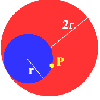
P is a point on the circumference of a circle radius r which rolls, without slipping, inside a circle of radius 2r. What is the locus of P?
Coke Machine
The coke machine in college takes 50 pence pieces. It also takes a certain foreign coin of traditional design...
Just Opposite
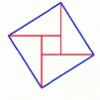
A and C are the opposite vertices of a square ABCD, and have coordinates (a,b) and (c,d), respectively. What are the coordinates of the vertices B and D? What is the area of the square?