Skip over navigation


A square stand designed to protect surfaces from hot pans is made from four $10 \; \text{cm}$ long pieces of cylindrical wooden dowel joined at the corners with $45$ degree mitres.
If the radius of the dowel used to make a stand is $0.5 \; \text{cm}$, what is the volume of wood used?
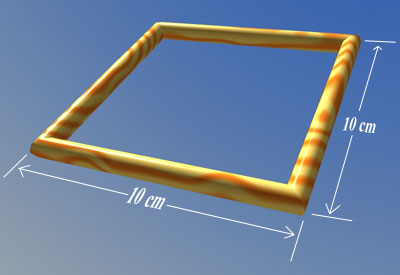
If I doubled the volume of wood used but did not change the radius of the dowel - what would the outside dimension of the stand be?
If, instead, I doubled the radius of the dowel but kept the same volume of wood, what would the outside dimension of the stand be then?
By looking in more detail at the effects of changing one of the variables at a time, can you describe any relationships between the volume of wood, the radius and the length of the dowel used?
Tubular Stand
Age 14 to 16
Challenge Level 
A square stand designed to protect surfaces from hot pans is made from four $10 \; \text{cm}$ long pieces of cylindrical wooden dowel joined at the corners with $45$ degree mitres.
If the radius of the dowel used to make a stand is $0.5 \; \text{cm}$, what is the volume of wood used?
If I doubled the volume of wood used but did not change the radius of the dowel - what would the outside dimension of the stand be?
If, instead, I doubled the radius of the dowel but kept the same volume of wood, what would the outside dimension of the stand be then?
By looking in more detail at the effects of changing one of the variables at a time, can you describe any relationships between the volume of wood, the radius and the length of the dowel used?
You may also like
Concrete Calculation
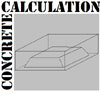
The builders have dug a hole in the ground to be filled with concrete for the foundations of our garage. How many cubic metres of ready-mix concrete should the builders order to fill this hole to make the concrete raft for the foundations?
In a Spin
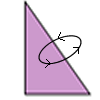
What is the volume of the solid formed by rotating this right angled triangle about the hypotenuse?