Skip over navigation


For this question you can only draw lines between points on the grid with integer coordinates, such as (6,-8,-2) or (3,7,0). You cannot draw lines between points that do not have integer coordinates e.g. (2.5,1,8) .
It is possible to draw a square of area 2 sq units on a coordinate grid so that two adjacent vertices are at the points (0,0) and (1,1) - see diagram below. In fact there are two such squares with sides $ \surd 2$ and area 2 square units - as shown.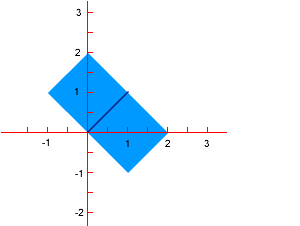
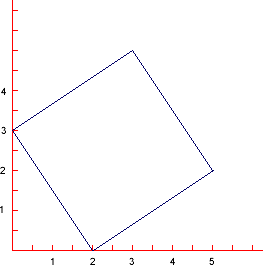
The Tilted Squares problem also investigates other squares you can draw by tilting the first side by different amounts. Here is a square with side: $ \surd 13$ and area 13 sq units.
It is not possible to draw a square of area 3 sq. units on the grid. Try some squares for yourself and then explain why.
But is it possible to draw a square of area 3 sq. units in a 3D grid? First, you need to be able to make a side of length $ \surd 3 $. The line joining (0,0,0) to (1,1,1) has a length of $\surd 3$. How do I know?
How many squares of area 3 square units can you find with this side in common, and what are the coordinates of their other vertices?

Something in Common
Age 14 to 16
Challenge Level 
For this question you can only draw lines between points on the grid with integer coordinates, such as (6,-8,-2) or (3,7,0). You cannot draw lines between points that do not have integer coordinates e.g. (2.5,1,8) .
It is possible to draw a square of area 2 sq units on a coordinate grid so that two adjacent vertices are at the points (0,0) and (1,1) - see diagram below. In fact there are two such squares with sides $ \surd 2$ and area 2 square units - as shown.
The Tilted Squares problem also investigates other squares you can draw by tilting the first side by different amounts. Here is a square with side: $ \surd 13$ and area 13 sq units.
It is not possible to draw a square of area 3 sq. units on the grid. Try some squares for yourself and then explain why.
But is it possible to draw a square of area 3 sq. units in a 3D grid? First, you need to be able to make a side of length $ \surd 3 $. The line joining (0,0,0) to (1,1,1) has a length of $\surd 3$. How do I know?
Then you need three more sides all the same length that meet at the vertices and are at right angles to each adjacent side.
How many squares of area 3 square units can you find with this side in common, and what are the coordinates of their other vertices?
You may also like
Just Opposite
A and C are the opposite vertices of a square ABCD, and have coordinates (a,b) and (c,d), respectively. What are the coordinates of the vertices B and D? What is the area of the square?
Ladder and Cube
A 1 metre cube has one face on the ground and one face against a wall. A 4 metre ladder leans against the wall and just touches the cube. How high is the top of the ladder above the ground?
Hypotenuse Lattice Points
The triangle OMN has vertices on the axes with whole number co-ordinates. How many points with whole number coordinates are there on the hypotenuse MN?