Skip over navigation


Go through the maze, collecting and losing your money as you go. You may not go through any cell more than once, and can only go into a cell through a gap, for example, you may not go from $5$ to $6$, or from $7$ to $3$.
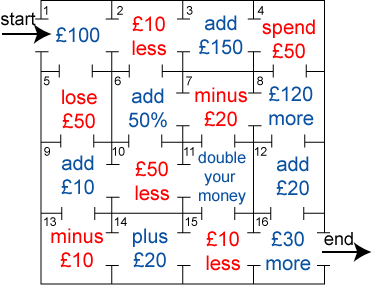
Which route gives you the highest return? How much is it?
Which route gives you the lowest return? How much is it?


The Money Maze
Age 7 to 11
Challenge Level 

The Money Maze
Go through the maze, collecting and losing your money as you go. You may not go through any cell more than once, and can only go into a cell through a gap, for example, you may not go from $5$ to $6$, or from $7$ to $3$.
Which route gives you the highest return? How much is it?
Which route gives you the lowest return? How much is it?
Why do this problem?
This problem gives learners the opportunity to practice addition, subtraction, multiplication and division of money, while it includes calculating with percentage. It is also a good context for developing a recording system and a systematic approach.
Possible approach
Pupils will need to develop their own recording system to show which routes they have tried. Encourage them to discuss how they know they have tried the different options so that they begin to see the need for a systematic approach.
This sheet has two copies of the maze on it.
Key questions
Have you thought of a way of recording the routes you have found?
How do you know that you have tried all the different ways through the maze?
How many ways are there to go from the first square?
Which one will you try first?
Are you sure there is a gap to go through between those two squares?
Possible extension
You could alter the maze adding a $50$% decrease and/or a further percentage increase or decrease, thus increasing the role of percentages in the problem.Possible support
Suggest trying to work out at least one way of going through the maze, then writing down the required calculations.You may also like
Christmas Shopping
Vera is shopping at a market with these coins in her purse. Which things could she give exactly the right amount for?
Buying a Balloon
Lolla bought a balloon at the circus. She gave the clown six coins to pay for it. What could Lolla have paid for the balloon?