Skip over navigation

Cambridge University Faculty of Mathematics NRich logo
menu search
  • Teachers expand_more
    • Early years
    • Primary
    • Secondary
    • Post-16
    • Events
    • Professional development
  • Students expand_more
    • Primary
    • Secondary
    • Post-16
  • Parents expand_more
    • Early Years
    • Primary
    • Secondary
    • Post-16
  • Problem-Solving Schools
  • About NRICH expand_more
    • About us
    • Impact stories
    • Support us
    • Our funders
    • Contact us
  • search

Or search by topic

Number and algebra

  • The Number System and Place Value
  • Calculations and Numerical Methods
  • Fractions, Decimals, Percentages, Ratio and Proportion
  • Properties of Numbers
  • Patterns, Sequences and Structure
  • Algebraic expressions, equations and formulae
  • Coordinates, Functions and Graphs

Geometry and measure

  • Angles, Polygons, and Geometrical Proof
  • 3D Geometry, Shape and Space
  • Measuring and calculating with units
  • Transformations and constructions
  • Pythagoras and Trigonometry
  • Vectors and Matrices

Probability and statistics

  • Handling, Processing and Representing Data
  • Probability

Working mathematically

  • Thinking mathematically
  • Developing positive attitudes
  • Cross-curricular contexts

Advanced mathematics

  • Decision Mathematics and Combinatorics
  • Advanced Probability and Statistics
  • Mechanics
  • Calculus

For younger learners

  • Early Years Foundation Stage

Coke Machine

Age 14 to 16
Challenge Level Yellow star
  • Problem
  • Getting Started
  • Student Solutions

This is another tough nut and perhaps the diagram of the 50p piece will help.

Fifty P
A 50 pence piece is a 7 sided polygon ABCDEFG with rounded edges, obtained by replacing the straight line DE with an arc centred at A and radius AE; replacing the straight line EF with an arc centred at B radius BF ...etc..

The 50p piece can roll in the same chute as a disc of radius $r$. Suppose the seven arcs forming the edge of the 50p piece (the arcs AB, BC etc. ) all have radius $R$ (where $R$=AD=AE=BE=BF...) then you need to find $R$ in terms of $r$. These seven arcs subtend angles of $2\pi /7$ at the centre of the disc and $2\pi /14$ at the opposite edge.
You may also like

Just Rolling Round

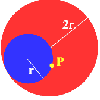
P is a point on the circumference of a circle radius r which rolls, without slipping, inside a circle of radius 2r. What is the locus of P?

Just Opposite

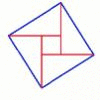
A and C are the opposite vertices of a square ABCD, and have coordinates (a,b) and (c,d), respectively. What are the coordinates of the vertices B and D? What is the area of the square?
Building Tetrahedra

Can you make a tetrahedron whose faces all have the same perimeter?

  • Tech help
  • Accessibility Statement
  • Sign up to our newsletter
  • Twitter X logo

The NRICH Project aims to enrich the mathematical experiences of all learners. To support this aim, members of the NRICH team work in a wide range of capacities, including providing professional development for teachers wishing to embed rich mathematical tasks into everyday classroom practice.

NRICH is part of the family of activities in the Millennium Mathematics Project.

University of Cambridge logo NRICH logo