Skip over navigation


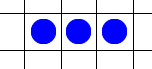
I have three counters. I arrange them on a grid to make a rectangle like this:
Using $2$cm squared paper and counters will help children to access this task.
Making Shapes
Age 5 to 7
Challenge Level 

Making Shapes
I have three counters. I arrange them on a grid to make a rectangle like this:
I wonder if there are any other rectangles I could make with just three counters?
If I had six counters, I could make a rectangle like this:
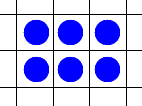
Are there any other rectangles that I could make with six counters?
Imagine you have $18$ counters to put on a grid.
Arrange any number of counters on the grid to make a rectangle (not just its outline).
How many different rectangles can you make with each number of counters?
If I had six counters, I could make a rectangle like this:
Are there any other rectangles that I could make with six counters?
Imagine you have $18$ counters to put on a grid.
Arrange any number of counters on the grid to make a rectangle (not just its outline).
How many different rectangles can you make with each number of counters?
Why do this problem?
This problem links shape with factors and multiples, and is a great way to introduce children to the idea of visualising numbers - in this case as rectangles or arrays.Possible approach
You could introduce the task on an interactive whiteboard and ask for a volunteer to make a rectangle to begin with. Invite children to suggest alternative rectangles using the same number of counters, and begin to discuss how you know whether there are any others.
Once the group has grasped the idea, they can explore in pairs using counters and $2$cm squared paper. Allowing them time to investigate in this way is very valuable, but you might like to bring the whole class together at various stages in order to discuss what they have found so far.
Once the group has grasped the idea, they can explore in pairs using counters and $2$cm squared paper. Allowing them time to investigate in this way is very valuable, but you might like to bring the whole class together at various stages in order to discuss what they have found so far.
Opportunities for use of language associated with shape and space are plentiful, and children will find it necessary to talk about the properties of rectangles. They can be encouraged to think about whether a square is a rectangle or not and will begin to mathematically justify opinions. The problem allows children to explore factors and multiples in a tactile way, and you can encourage them
to talk about whether $2\times3$ is the same as $3\times2$.
(You may like to use this interactivity but it only allows counters to be placed where grid lines cross, rather than in the squares.)
Key questions
How about starting with a small number of counters and working up?
How will you know that you haven't missed any out?
Possible extension
Introduce more counters for children to continue the investigation.
Possible support
Using $2$cm squared paper and counters will help children to access this task.You may also like
Biscuit Decorations
Andrew decorated 20 biscuits to take to a party. He lined them up and put icing on every second biscuit and different decorations on other biscuits. How many biscuits weren't decorated?
Constant Counting
You can make a calculator count for you by any number you choose. You can count by ones to reach 24. You can count by twos to reach 24. What else can you count by to reach 24?