Skip over navigation


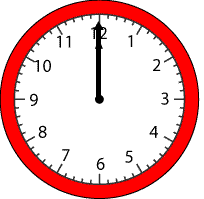
In $10$ minutes, through how many degrees does the minute hand of the clock sweep?
In $3$ hours, how many degrees does the hour hand of the clock sweep through?
If the minute hand goes through $180^{\circ}$, how many degrees does the hour hand sweep?



Sweeping Hands
Age 7 to 11
Challenge Level 

Sweeping Hands
In $10$ minutes, through how many degrees does the minute hand of the clock sweep?
In $3$ hours, how many degrees does the hour hand of the clock sweep through?
If the minute hand goes through $180^{\circ}$, how many degrees does the hour hand sweep?
Why do this problem?
This problem is a great context in which to apply knowledge of angles based on a full turn and it helps to consolidate analogue clock features too.
Having a large geared demonstration clock available would be a good idea to discuss this problem with the group.
Key questions
Which is the minute hand and which is the hour hand?
How long does it take the hour hand do go a full circle ($360$ $^\circ$) round the clock?
How long does it take the minute hand do go a full circle round the clock?
How many degrees does the minute hand go through in one hour?
So many degrees does it go through in $15$ minutes? In $10$ minutes?
So, how many degrees does it go through in $5$ minutes?
Possible extension
Learners could go on to either of these two problems - Watch the Clock or Two Clocks .
Possible support
Suggest doing this problem, Two Clocks or possibly just exploring the interactivity to see how clocks move.You may also like
Times
Which times on a digital clock have a line of symmetry? Which look the same upside-down? You might like to try this investigation and find out!
Clock Hands
This investigation explores using different shapes as the hands of the clock. What things occur as the the hands move.
Ten Green Bottles
Do you know the rhyme about ten green bottles hanging on a wall? If the first bottle fell at ten past five and the others fell down at 5 minute intervals, what time would the last bottle fall down?