

Area I'n It


Both Sue Liu, Madras College, St Andrews and Vassil Vassilev, Lawnswood High School, Leeds solved this one, well done!
Triangle $ABC$ has altitudes $h_1$, $h_2$ and $h_3$. The radius of the inscribed circle is $r$, while the radii of the escribed circles are $r_1$, $r_2$ and $r_3$. We prove that $${1\over r} = {1\over h_1} + {1\over h_2} + {1\over h_3} = {1\over r_1} + {1\over r_2} + {1\over r_3}.$$ Let $\Delta$ be the area of the triangle $ABC$ and let $X$ be the centre of the inscribed circle.

Clearly, $$\Delta = {\textstyle{1\over 2}}r.AB+ {\textstyle{1\over 2}}r.BC+ {\textstyle{1\over 2}}r.CA,$$ so that $${1\over r} = {AB + BC + CA\over 2\Delta}.$$ Also, $$\Delta = {\textstyle{1\over 2}}h_1.BC = {\textstyle{1\over 2}}h_2, \quad CA = {\textstyle{1\over 2}}h_3.AB,$$ thus $${1\over h_1} + {1\over h_2} + {1\over h_3} ={BC + CA + AB\over 2\Delta} = {1\over r}.$$ Now let $A'$, $B'$ and $C'$ be the centres of the escribed circles; see the diagram below. Also, for any triangle with vertices $U$, $V$ and $W,$ let $\Delta(U,V,W)$ denote its area.

Considering the area of the kite $ABA'C$ by splitting it into two triangles in two different ways we get $$\Delta(A,B,C)+\Delta(B,A',C) = {\rm area}(ABA'C) = \Delta(A,B,A') + \Delta(A,C,A').$$ This gives (with $\Delta = \Delta(A,B,C))$ $$\Delta +{\textstyle{1\over 2}}r_1.BC = {\textstyle{1\over 2}}r_1.AB + {\textstyle{1\over 2}}r_1.CA,$$ and hence $${2\Delta\over r_1}= AB + CA - BC.$$ Similarly, $${2\Delta\over r_2}= AB + BC - CA, \quad {2\Delta\over r_3}= CA + BC - AB,$$ and adding these we get $$\eqalign{ 2\Delta\left({1\over r_1}+{1\over r_2}+{1\over r_C}\right) &= (AB + CA - BC) + (AB + BC - CA) + (CA + BC - AB) \cr &= (AB + BC + CA) \cr &= {2\Delta\over r}}$$ as required.
You may also like
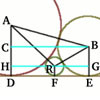
Baby Circle
A small circle fits between two touching circles so that all three circles touch each other and have a common tangent? What is the exact radius of the smallest circle?
Kissing
Two perpendicular lines are tangential to two identical circles that touch. What is the largest circle that can be placed in between the two lines and the two circles and how would you construct it?
Logosquares
Ten squares form regular rings either with adjacent or opposite vertices touching. Calculate the inner and outer radii of the rings that surround the squares.