Skip over navigation


Why do this problem?
The numerical examples should prompt learners to formulate and prove a more general statement and then apply it to these special cases. Going from the particular to the general in problem solving is an important skill for a mathematician.
Inequalities play a big role in advanced mathematics and mathematical research and learners in school will benefit from experience of working with inequalities.
They need to know the Binomial Theorem and the formula for the exponential series and then the problem gives experience of applying these formulae and of proof by mathematical induction.
Possible approach
The first part could be a lesson starter or homework in preparation for a lesson or you could do the first part as a class and set the two numerical examples to be done independently.
Key questions
How do the numerical examples relate to $(1 +\frac{1}{n})^n$?


Growing
Age 16 to 18
Challenge Level 

Why do this problem?
The numerical examples should prompt learners to formulate and prove a more general statement and then apply it to these special cases. Going from the particular to the general in problem solving is an important skill for a mathematician.
Inequalities play a big role in advanced mathematics and mathematical research and learners in school will benefit from experience of working with inequalities.
They need to know the Binomial Theorem and the formula for the exponential series and then the problem gives experience of applying these formulae and of proof by mathematical induction.
Possible approach
The first part could be a lesson starter or homework in preparation for a lesson or you could do the first part as a class and set the two numerical examples to be done independently.
Key questions
How do the numerical examples relate to $(1 +\frac{1}{n})^n$?
You may also like
Telescoping Series
Find $S_r = 1^r + 2^r + 3^r + ... + n^r$ where r is any fixed positive integer in terms of $S_1, S_2, ... S_{r-1}$.
Climbing Powers
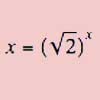
$2\wedge 3\wedge 4$ could be $(2^3)^4$ or $2^{(3^4)}$. Does it make any difference? For both definitions, which is bigger: $r\wedge r\wedge r\wedge r\dots$ where the powers of $r$ go on for ever, or $(r^r)^r$, where $r$ is $\sqrt{2}$?