Skip over navigation


Euler found four whole numbers such that the sum of any two of the numbers is a perfect square. Three of the numbers that he found are \begin{equation*} a= 18530, \quad b=65570, \quad c=45986. \end{equation*}
Find the fourth number, $x$. You could do this by trial and error (sometimes called trial and improvement), and a spreadsheet would be a good tool for such work. However, Euler would not have used any electronic calculating aids to find his 'fearsome foursome' and he would have found ways of reducing the search to a small number of cases and this is what you should try to do. You could do this by writing down \begin{equation*} a+x = P^2 \end{equation*} \begin{equation*} b+x = Q^2 \end{equation*} \begin{equation*} c+x = R^2, \end{equation*}
and then focussing on $ Q^{2}-R^2=b-c $ which is known. Moreover you know that $ Q > \sqrt{b} $ and $ R> \sqrt{c} $. Use this to show that $ Q-R \leq 41 $. Use a spreadsheet to calculate values of $ Q+R $, $ Q$ and $ x $ for values of $ Q-R $ from $ 1 $ to $ 41 $, and hence to find the value of $ x $ for which $ a+x $ is a perfect square.
There may be better ways to do this, and if you find one, do let us know!

Euler's Squares
Age 14 to 16
Challenge Level 

Euler found four whole numbers such that the sum of any two of the numbers is a perfect square. Three of the numbers that he found are \begin{equation*} a= 18530, \quad b=65570, \quad c=45986. \end{equation*}
Find the fourth number, $x$. You could do this by trial and error (sometimes called trial and improvement), and a spreadsheet would be a good tool for such work. However, Euler would not have used any electronic calculating aids to find his 'fearsome foursome' and he would have found ways of reducing the search to a small number of cases and this is what you should try to do. You could do this by writing down \begin{equation*} a+x = P^2 \end{equation*} \begin{equation*} b+x = Q^2 \end{equation*} \begin{equation*} c+x = R^2, \end{equation*}
and then focussing on $ Q^{2}-R^2=b-c $ which is known. Moreover you know that $ Q > \sqrt{b} $ and $ R> \sqrt{c} $. Use this to show that $ Q-R \leq 41 $. Use a spreadsheet to calculate values of $ Q+R $, $ Q$ and $ x $ for values of $ Q-R $ from $ 1 $ to $ 41 $, and hence to find the value of $ x $ for which $ a+x $ is a perfect square.
There may be better ways to do this, and if you find one, do let us know!
You may also like
DOTS Division
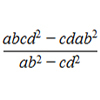
Take any pair of two digit numbers x=ab and y=cd where, without loss of generality, ab > cd . Form two 4 digit numbers r=abcd and s=cdab and calculate: {r^2 - s^2} /{x^2 - y^2}.
2-digit Square
A 2-Digit number is squared. When this 2-digit number is reversed and squared, the difference between the squares is also a square. What is the 2-digit number?
Odd Differences
The diagram illustrates the formula: 1 + 3 + 5 + ... + (2n - 1) = n² Use the diagram to show that any odd number is the difference of two squares.