Skip over navigation
Cambridge University Faculty of Mathematics NRich logo
menu search
  • Teachers expand_more
    • Early years
    • Primary
    • Secondary
    • Post-16
    • Events
    • Professional development
  • Students expand_more
    • Primary
    • Secondary
    • Post-16
  • Parents expand_more
    • Early Years
    • Primary
    • Secondary
    • Post-16
  • Problem-Solving Schools
  • About NRICH expand_more
    • About us
    • Impact stories
    • Support us
    • Our funders
    • Contact us
  • search

Or search by topic

Number and algebra

  • The Number System and Place Value
  • Calculations and Numerical Methods
  • Fractions, Decimals, Percentages, Ratio and Proportion
  • Properties of Numbers
  • Patterns, Sequences and Structure
  • Algebraic expressions, equations and formulae
  • Coordinates, Functions and Graphs

Geometry and measure

  • Angles, Polygons, and Geometrical Proof
  • 3D Geometry, Shape and Space
  • Measuring and calculating with units
  • Transformations and constructions
  • Pythagoras and Trigonometry
  • Vectors and Matrices

Probability and statistics

  • Handling, Processing and Representing Data
  • Probability

Working mathematically

  • Thinking mathematically
  • Developing positive attitudes
  • Cross-curricular contexts

Advanced mathematics

  • Decision Mathematics and Combinatorics
  • Advanced Probability and Statistics
  • Mechanics
  • Calculus

For younger learners

  • Early Years Foundation Stage

Tri.'s

Age 7 to 11
Challenge Level Yellow star
  • Problem
  • Getting Started
  • Student Solutions
  • Teachers' Resources

Tri's


Many schools that I have worked in, which is quite a lot, have used nail boards with elastic bands to do some work on shape. Sometimes they have some plastic ones which do the same job and are less painful when you lean on them. Well this challenge is to use an idea that started with using nailboards like these but has changed into using 9 dots arranged in a square to be like a small 3 by 3 nail board.

If you use three lines, (like you may have had three elastic bands for a nail board) see what triangles you can make just using these nine dots. The lines MUST go from dot to dot, (like an elastic band has to go from nail to nail).

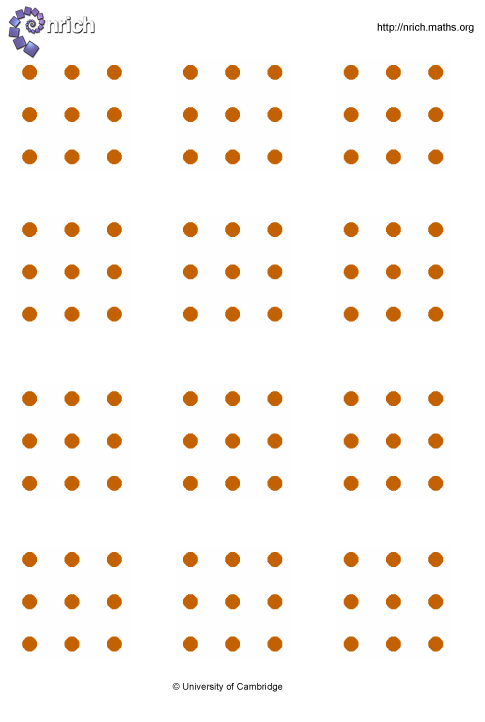
The recording of these can get very confused so I suggest that you draw each new triangle on a new set of 9 dots. There are some to print off here .
One thing which makes this challenge a little different is that if you produce the same shaped triangle but place it in a different position on the 9 dots then it can be counted as being different.
Notice also that there are some triangles that you can make that do not have their vertices (corners) on the dots but they still obey the rules:-

1) Use three straight lines only.

2) Each line must go from a dot to a dot.

3) You can only use these 9 dots arranged as shown.


Well now, what about the smallest one?

Have you used any kind of system to get all the ones that are the same shape but put in different places?

How many of each triangle have you found?

Finally, the usual question for you to ask, "I wonder what would happen if ...?"

Don't forget to send in solutions and ideas and things that you have found out.


Why do this problem?

This problem is ideal for helping pupils get a broader idea about triangles. It also gives the pupils a chance to use their natural curiosity to pose questions for them to solve themselves. Asking the question "I wonder what would happen if I...? is a good way to start, and perseverance will possibly take them to a new understanding of triangles.

Possible approach

If you are working with young children then I would use nail boards for this challenge, but provide the youngsters with prepared dotted paper with 3 by 3s easily seen (you could print off this sheet of grids). It is best to use those boards that have the nails as far apart as possible (the old inch ones are good and it is important to use three bands, one for each line that constructs the triangle). They may need help initially in transferring their ideas from the boards to the paper.

With older children you may be able to dispense with the boards almost straight away and get them using the paper only. This allows the children to work quite quickly.

You could use the virtual geoboard to share ideas on the interactive whiteboard.

Key questions

Tell me about this triangle you've made.
Is this triangle SMALLER, THE SAME SIZE or BIGGER than this one?

Possible extension

The area of these triangles can be considered by some pupils, but difficulties will probably arise when it comes to the smaller triangles that are "hung" between the dots with no vertex at a dot. Fairly obvious extensions of using 4 by 4 dots and using four lines to produce squares (probably best to start with a 4 by 4 for squares) will captivate some children. Last but not least those children who like doing things neatly and take care in presentation can produce delightful work that can be displayed in school and attract attention to the work of investigations in school.

For more extension work

spot cube
Consider a cube with $9$ holes in each face, feed string through a hole and out through another one on another face. What triangles or tetrahedrons can you form inside the cube?

Possible support

Many youngsters will be encouraged when their teacher joins in the activity with them.


You may also like

Cutting Corners

Can you make the most extraordinary, the most amazing, the most unusual patterns/designs from these triangles which are made in a special way?
Bracelets

Investigate the different shaped bracelets you could make from 18 different spherical beads. How do they compare if you use 24 beads?
Tessellating Triangles

Can you make these equilateral triangles fit together to cover the paper without any gaps between them? Can you tessellate isosceles triangles?

  • Tech help
  • Accessibility Statement
  • Sign up to our newsletter
  • Twitter X logo

The NRICH Project aims to enrich the mathematical experiences of all learners. To support this aim, members of the NRICH team work in a wide range of capacities, including providing professional development for teachers wishing to embed rich mathematical tasks into everyday classroom practice.

NRICH is part of the family of activities in the Millennium Mathematics Project.

University of Cambridge logo NRICH logo