Skip over navigation


David provided us with his solution:

I firstly used the angles calculated in *** and put them on the diagram. Next I used the fact that $ \sin30=1/2$ (this isn't too difficult to prove), to find that $z=30$ degrees. From this, I could work out all the other angles and fill them in:

from this all the sine, cosine and tangent values can be read off.
For the final part, I noticed when
$x = \sqrt{2} + 1$ and $y = 1$ then $SD$ and $AS$ are the same length. This makes $SDR$ and $SAP$ similar triangles, and so the angle $DSR$ is $22.5$ degrees. So we get:

From which all the sine, cosine and tangent values of $22.5$ degrees can be obtained.
Strange Rectangle 2
Age 16 to 18
Challenge Level 

David provided us with his solution:
I firstly used the angles calculated in *** and put them on the diagram. Next I used the fact that $ \sin30=1/2$ (this isn't too difficult to prove), to find that $z=30$ degrees. From this, I could work out all the other angles and fill them in:
from this all the sine, cosine and tangent values can be read off.
For the final part, I noticed when
$x = \sqrt{2} + 1$ and $y = 1$ then $SD$ and $AS$ are the same length. This makes $SDR$ and $SAP$ similar triangles, and so the angle $DSR$ is $22.5$ degrees. So we get:
From which all the sine, cosine and tangent values of $22.5$ degrees can be obtained.
You may also like
Set Square
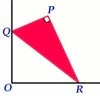
A triangle PQR, right angled at P, slides on a horizontal floor with Q and R in contact with perpendicular walls. What is the locus of P?
Biggest Bendy
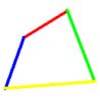
Four rods are hinged at their ends to form a quadrilateral. How can you maximise its area?
Strange Rectangle
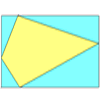
ABCD is a rectangle and P, Q, R and S are moveable points on the edges dividing the edges in certain ratios. Strangely PQRS is always a cyclic quadrilateral and you can find the angles.