Skip over navigation


Investigate the family of graphs given by the equation
$$x ^3+y^3=3axy$$
for different values of the constant $a$.
It is more of a challenge to try to sketch the graphs with the ideas explored in this question without graphing software but you may like to use it if you have software that plots the graphs of implicit functions or parametric functions.
Prove that the graphs are all symmetrical about the line $y=x$.
Make the substitution $y=tx$ to express the equation in parametric form $(x,y)=(f(t),g(t))$.
Show that all the graphs have a maximum point when $t=2^{1/3}$ and find the coordinates of the maximum point.
Show that:
a) for $-\infty< t< -1$ the graphs lies in the fourth quadrant with $x$ positive and $y$ negative
b) for $-1< t< 0$ the graphs lie in the second quadrant with $x$ negative and $y$ positive
c) for $0< t< 1$ the graphs lie in the first quadrant with $0< y< x$
d) for $1< t< +\infty$ the graphs lie in the first quadrant with $0< x< y$.
What happens to the graphs for $t=-1$?
Folium of Descartes
Age 16 to 18
Challenge Level 
Investigate the family of graphs given by the equation
$$x ^3+y^3=3axy$$
for different values of the constant $a$.
It is more of a challenge to try to sketch the graphs with the ideas explored in this question without graphing software but you may like to use it if you have software that plots the graphs of implicit functions or parametric functions.
Prove that the graphs are all symmetrical about the line $y=x$.
Make the substitution $y=tx$ to express the equation in parametric form $(x,y)=(f(t),g(t))$.
Show that all the graphs have a maximum point when $t=2^{1/3}$ and find the coordinates of the maximum point.
Show that:
a) for $-\infty< t< -1$ the graphs lies in the fourth quadrant with $x$ positive and $y$ negative
b) for $-1< t< 0$ the graphs lie in the second quadrant with $x$ negative and $y$ positive
c) for $0< t< 1$ the graphs lie in the first quadrant with $0< y< x$
d) for $1< t< +\infty$ the graphs lie in the first quadrant with $0< x< y$.
What happens to the graphs for $t=-1$?
You may also like
Power Up
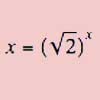
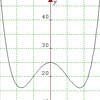
Show without recourse to any calculating aid that 7^{1/2} + 7^{1/3} + 7^{1/4} < 7 and 4^{1/2} + 4^{1/3} + 4^{1/4} > 4 . Sketch the graph of f(x) = x^{1/2} + x^{1/3} + x^{1/4} -x