Skip over navigation


Nick Lord chose this problem for the 10th Anniversary Edition of the NRICH website and had this to say about it:
"The equilateral case is genuinely surprising; the square case echoes back through the centuries to Euclid's original construction of the golden section, as does the familiar 'diagonal:side' ratio in the pentagon. I say 'familiar' in that annoying way that teachers often do, forgetting that everyone has to encounter beautiful results like this for the first time and that they will struggle to find them in today's school textbooks. It is fantastic to have such gems collated in such a convenient form in one place - gems which I can customise for my own teaching purposes. For example, adjacent to 'Gold Yet Again' on the menu is 'Pentabuild' so, at the click of a button, I can animate the construction of a regular pentagon and we can hunt for the tell-tale evidence of the golden ratio which we now know is needed to make it work. By the end of all this, my students' mathematics has been enriched, my mathematics has been enriched and I log-off smiling that I have struck 'Gold Again' on the NRICH website! "
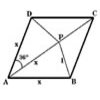
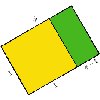
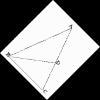
This problem gives three examples of the occurrence of the golden ratio.
For the pentagon, the hint suggests you use the similar triangles which have angles $72^\circ, 72^\circ$ and $36^\circ$, one with sides $x$, $x$ and $1$ and one with sides $1$, $1$ and $x-1$. Equating the ratios of corresponding sides of these triangles gives a quadratic equation.
Gold Yet Again
Age 16 to 18
Challenge Level 
Nick Lord chose this problem for the 10th Anniversary Edition of the NRICH website and had this to say about it:
"The equilateral case is genuinely surprising; the square case echoes back through the centuries to Euclid's original construction of the golden section, as does the familiar 'diagonal:side' ratio in the pentagon. I say 'familiar' in that annoying way that teachers often do, forgetting that everyone has to encounter beautiful results like this for the first time and that they will struggle to find them in today's school textbooks. It is fantastic to have such gems collated in such a convenient form in one place - gems which I can customise for my own teaching purposes. For example, adjacent to 'Gold Yet Again' on the menu is 'Pentabuild' so, at the click of a button, I can animate the construction of a regular pentagon and we can hunt for the tell-tale evidence of the golden ratio which we now know is needed to make it work. By the end of all this, my students' mathematics has been enriched, my mathematics has been enriched and I log-off smiling that I have struck 'Gold Again' on the NRICH website! "
This problem gives three examples of the occurrence of the golden ratio.
For the pentagon, the hint suggests you use the similar triangles which have angles $72^\circ, 72^\circ$ and $36^\circ$, one with sides $x$, $x$ and $1$ and one with sides $1$, $1$ and $x-1$. Equating the ratios of corresponding sides of these triangles gives a quadratic equation.
Another method of proving the same result is given in
Pent
There is a related problem called
Gold Again
You may also like
Gold Again
Without using a calculator, computer or tables find the exact values of cos36cos72 and also cos36 - cos72.
Pythagorean Golden Means
Show that the arithmetic mean, geometric mean and harmonic mean of a and b can be the lengths of the sides of a right-angles triangle if and only if a = bx^3, where x is the Golden Ratio.
Golden Triangle
Three triangles ABC, CBD and ABD (where D is a point on AC) are all isosceles. Find all the angles. Prove that the ratio of AB to BC is equal to the golden ratio.