Skip over navigation
Cambridge University Faculty of Mathematics NRich logo
menu search
  • Teachers expand_more
    • Early years
    • Primary
    • Secondary
    • Post-16
    • Events
    • Professional development
  • Students expand_more
    • Primary
    • Secondary
    • Post-16
  • Parents expand_more
    • Early Years
    • Primary
    • Secondary
    • Post-16
  • Problem-Solving Schools
  • About NRICH expand_more
    • About us
    • Impact stories
    • Support us
    • Our funders
    • Contact us
  • search

Or search by topic

Number and algebra

  • The Number System and Place Value
  • Calculations and Numerical Methods
  • Fractions, Decimals, Percentages, Ratio and Proportion
  • Properties of Numbers
  • Patterns, Sequences and Structure
  • Algebraic expressions, equations and formulae
  • Coordinates, Functions and Graphs

Geometry and measure

  • Angles, Polygons, and Geometrical Proof
  • 3D Geometry, Shape and Space
  • Measuring and calculating with units
  • Transformations and constructions
  • Pythagoras and Trigonometry
  • Vectors and Matrices

Probability and statistics

  • Handling, Processing and Representing Data
  • Probability

Working mathematically

  • Thinking mathematically
  • Developing positive attitudes
  • Cross-curricular contexts

Advanced mathematics

  • Decision Mathematics and Combinatorics
  • Advanced Probability and Statistics
  • Mechanics
  • Calculus

For younger learners

  • Early Years Foundation Stage

Domino Sorting

Age 5 to 7
Challenge Level Yellow star
Primary curriculum
  • Problem
  • Getting Started
  • Student Solutions
  • Teachers' Resources

Domino Sorting

Domino Sorting printable sheet

ere are some dominoes taken out of the full set:
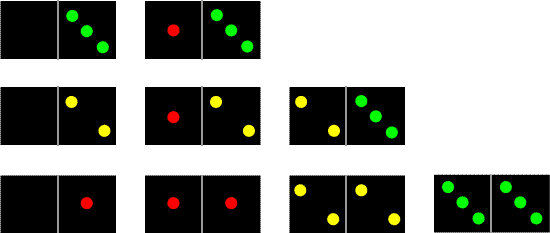
dominoes from 1, 0 to 3, 3
 
Sort them into two groups - one group with an odd number of spots and one group with an even number of spots.
Do you have any dominoes left over? Why or why not?
 
Now put the dominoes into pairs. The number of spots on each pair of dominoes must make a total of $5$.
How many pairs can you make?
Which dominoes are left over?
 
Can you pair them up in any different ways so that each pair adds to $5$?
Which dominoes are left over now?
 
Are there any dominoes which are always left over?
Can you explain why?


Why do this problem?

This problem will help learners to become more familiar with odd and even numbers, and number bonds to five. It will also challenge them to justify findings.

Possible approach

If you have an interactive whiteboard, you may find our Dominoes Environment useful for this problem.

You might like to start by giving pairs of children a whole set of dominoes to explore and ask them some open-ended questions such as:
  • How can you sort them?
  • Can you make a pattern?
  • Can you make a snake?
  • What did you notice?
Learners can then find the subset of dominoes that they need for this task and tackle it in pairs. It will provoke a lot of meaningful discussion and will give pupils the experience of having to argue mathematically.
In a plenary, focus on the "can you explain why?"- the beginning of an understanding of proof. The sooner we start children justifying their conclusions, the better mathematicians they'll turn out to be!

Key questions

Can you think of some pairs of numbers that add to five?
Have you added up or counted the spots on each domino?
Which domino could you pair with this one so that there are five spots altogether?

Possible extension

You might want some children to find all the different ways of making pairs that add to $5$. This could be by picking two and then replacing them, or by finding all the different combinations which could be made at the same time (the problem as written focuses on the latter). Whichever way, part of their task should be to convince you that they have not missed any pairs out.
Domino Join Up is a similar problem which gives practice in number bonds to six, and could be used as an extension to this problem.

Possible support

Children would really benefit from having sets of dominoes to manipulate as this allows them to change their mind easily, so giving them more confidence to begin the task, and also prevents them from using any domino twice.


You may also like
Three Squares

What is the greatest number of squares you can make by overlapping three squares?

Two Dice

Find all the numbers that can be made by adding the dots on two dice.

Biscuit Decorations

Andrew decorated 20 biscuits to take to a party. He lined them up and put icing on every second biscuit and different decorations on other biscuits. How many biscuits weren't decorated?

  • Tech help
  • Accessibility Statement
  • Sign up to our newsletter
  • Twitter X logo

The NRICH Project aims to enrich the mathematical experiences of all learners. To support this aim, members of the NRICH team work in a wide range of capacities, including providing professional development for teachers wishing to embed rich mathematical tasks into everyday classroom practice.

NRICH is part of the family of activities in the Millennium Mathematics Project.

University of Cambridge logo NRICH logo