

Tweedle Dum and Tweedle Dee

There are many solutions to this problem. Here is one correct solution received from a student at West Flegg Middle School in Norfolk.
| Dee | Dum |
| 48 | 28 |
| 32 | 44 |
| 54 | 22 |
| 18 | 58 |
| 61.50 | 14.50 |
| 20.50 | 55.50 |
| 39 | 37 |
| 38 | 38 |
Hence, they share 76 pounds between them.
Year 5 pupils at Sutton High School also found a couple of solutions.
Ewan, from King Edward VII School in Sheffield, used algebra to make sure he found all the possible solutions.
Let DUM begin with $x$ and DEE with $y$ coins. Note that $x < y$.
Following the giving of money algebraically the table shows DUM and DEE's fortunes after each gift:
| DUM | DEE |
| $x$ | $y$ |
| $x+\frac{1}{3}y$ | $\frac{2}{3}y$ |
| $\frac{1}{2}x+\frac{1}{6}y$ | $\frac{1}{2}x+\frac{5}{6}y$ |
| $\frac{5}{6}x+\frac{13}{8}y$ | $\frac{1}{6}x+\frac{5}{8}y$ |
| $\frac{5}{24}x+\frac{13}{72}y$ | $\frac{19}{24}x+\frac{59}{72}y$ |
| $\frac{53}{72}x+\frac{157}{216}y$ | $\frac{19}{72}x+\frac{59}{216}y$ |
| $\frac{53}{108}x+\frac{157}{324}y$ | $\frac{55}{108}x+\frac{167}{324}y$ |
After the last 'gift' of $1$ coin, we know that the totals are equal, so
\begin{align}
\frac{53}{108}x+\frac{157}{324}y+1 &= \frac{55}{108}x+\frac{167}{324}y -1 \\
2 &= \frac{2}{108}x+\frac{5}{162}y \\
324 &= 3x + 5y
\end{align}
Whole-number solutions of this equation are found by noticing that since $3x$ and $5y$ appear, if we introduce $n$ such that $x = 5n+a$ and $y=-3n+b$ then $n$ will cancel from the equation so we may find values for $a$ and $b$. One such solution is
\begin{align}
x &= 5n+3 & y&=-3n +63,
\end{align}
but different values of $a$ and $b$ are possible.
Can you see why different values of $a$ and $b$ are possible? Can you convince yourself that as $n$ varies any correct values of $a$ and $b$ will give all the solutions? You could also solve the equation $324 = 3x + 5y$ by drawing a graph and finding where it goes through points with whole number coordinates.
Since we know $0 < x < y$ we have the solutions:
| $x$ | $y$ | Total |
| $3$ | $63$ | $66$ |
| $8$ | $60$ | $68$ |
| $13$ | $57$ | $70$ |
| $18$ | $54$ | $72$ |
| $23$ | $51$ | $74$ |
| $28$ | $48$ | $76$ |
| $33$ | $45$ | $78$ |
| $38$ | $42$ | $80$ |
Well done Ewan! Remember that even though these solutions have come from looking at the algebra, they might not work. For instance neither DUM nor DEE can ever give away exactly $1/3$ of a pound! You could check the 'gifts' in each solution for $x$ and $y$ to make sure that this never happens.
You may also like
Sum Equals Product
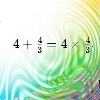
The sum of the numbers 4 and 1 [1/3] is the same as the product of 4 and 1 [1/3]; that is to say 4 + 1 [1/3] = 4 � 1 [1/3]. What other numbers have the sum equal to the product and can this be so for any whole numbers?
Special Sums and Products
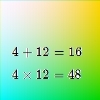
Find some examples of pairs of numbers such that their sum is a factor of their product. eg. 4 + 12 = 16 and 4 × 12 = 48 and 16 is a factor of 48.

As Easy as 1,2,3
When I type a sequence of letters my calculator gives the product of all the numbers in the corresponding memories. What numbers should I store so that when I type 'ONE' it returns 1, and when I type 'TWO' it returns 2, and so on.