Skip over navigation


In the problem The Cantor Set, we met the Cantor set, which is the limit of $C_n$ as $n$ tends to infinity.
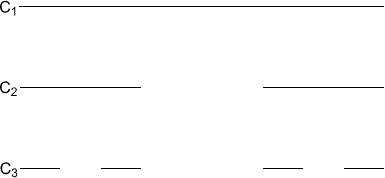
We can talk about the length of one of our sets $C_n$.
The set $C_1$ has length 1.
The set $C_2$ has length $\frac{2}{3}$, as this is the total length of the line segments in $C_2$.
What are the lengths of $C_3$, $C_4$ and $C_5$?
Can you find a general expression for the length of $C_n$?
By considering what happens as $n$ tends to infinity, can you find the length of the Cantor set?

How Long Is the Cantor Set?
Age 11 to 14
Challenge Level 
In the problem The Cantor Set, we met the Cantor set, which is the limit of $C_n$ as $n$ tends to infinity.
We can talk about the length of one of our sets $C_n$.
The set $C_1$ has length 1.
The set $C_2$ has length $\frac{2}{3}$, as this is the total length of the line segments in $C_2$.
What are the lengths of $C_3$, $C_4$ and $C_5$?
Can you find a general expression for the length of $C_n$?
By considering what happens as $n$ tends to infinity, can you find the length of the Cantor set?
You may also like
Tweedle Dum and Tweedle Dee
Two brothers were left some money, amounting to an exact number of pounds, to divide between them. DEE undertook the division. "But your heap is larger than mine!" cried DUM...
Sum Equals Product
The sum of the numbers 4 and 1 [1/3] is the same as the product of 4 and 1 [1/3]; that is to say 4 + 1 [1/3] = 4 � 1 [1/3]. What other numbers have the sum equal to the product and can this be so for any whole numbers?
Special Sums and Products
Find some examples of pairs of numbers such that their sum is a factor of their product. eg. 4 + 12 = 16 and 4 × 12 = 48 and 16 is a factor of 48.