Skip over navigation


In Tangram Tangle you will find one of our problems is based on a simple tangram. A tangram is a shape (often a square) which is split into several different pieces. These can then be fitted together to make new shapes. Did you know that tangrams were first invented in China? Here we will show you how to make a tangram.
What fantastic shapes can you make using the three pieces? You could try using different ways of fitting the shapes together - start by matching sides of the same length together, corner to corner. Then see what you can do if you allow yourself just to place the pieces next to each other in any way, as long as they touch each other.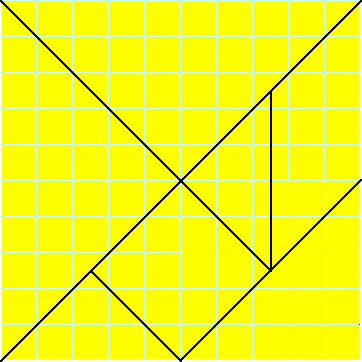
You could try making these Christmas-themed pictures with your seven-piece tangram. (Here are the answers - but don't look yet!)
Making Maths: Making a Tangram
Age 7 to 11
Challenge Level 

In Tangram Tangle you will find one of our problems is based on a simple tangram. A tangram is a shape (often a square) which is split into several different pieces. These can then be fitted together to make new shapes. Did you know that tangrams were first invented in China? Here we will show you how to make a tangram.
You'll need:
- Ruler
- Pencil
- Coloured pens or pencils
- Scissors
- Squared paper
- Thin card (optional)
- Glue (optional)
What to do:
- Draw a square onto the squared paper. A good size is $10$cm by $10$cm, but it doesn't really matter. Try to be as accurate as possible when drawing the square as this will help later!
- Mark the midpoint of the bottom side of your square with a small line or dot.
- Using your ruler, join this point to the top right corner of the square, like this:

- Line your ruler up with the diagonal that joins the top left and bottom right corners. Draw a line along this diagonal from the top left corner but stop when you meet the line you drew in step $3$. Your square should now look like this:

- Next colour your square. You may like to make each part a different colour, or simply shade the whole square in the same colour. You may need to go over the lines you've drawn in a black pen.
- Cut out your square. At this point, you could stick the square onto card and cut it out again. This may make your tangram a bit stronger.
- Cut along the lines you've drawn so that you now have three pieces which fit together to make the original square.
What fantastic shapes can you make using the three pieces? You could try using different ways of fitting the shapes together - start by matching sides of the same length together, corner to corner. Then see what you can do if you allow yourself just to place the pieces next to each other in any way, as long as they touch each other.
Perhaps you can make some funny figures or outlines of everyday objects. When you've made something you like, you could perhaps sketch out how the three shapes fit together so you don't forget. Then you could just draw the outline and challenge someone else to make it.
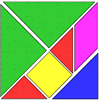
If you're feeling very adventurous, you may like to make a seven-piece tangram which is used in all the World of Tan activties (put 'world of tan' into the search box in the top right of NRICH to find them). This is what it looks like: