Skip over navigation


What is infinity plus one? This may be a sufficient hint to help you solve the problem. Have a go before reading any further.
An alternative method is to start with simple cases. When we have an infinite system we often start with $n=1$ and 2, 3, ... and try to find a formula for $n$ and then calculate its limit as ${n\to \infty}$. Very often this method of solving a problem is the best one but not always. In this case the method leads to an infinite continued fraction which can be evaluated to give the required value of the resistance.
Resistance
Age 16 to 18
Challenge Level 
What is infinity plus one? This may be a sufficient hint to help you solve the problem. Have a go before reading any further.
 |
One approach to solving problems involving an infinite system
like this one is to focus on the idea of infinity and its
properties. Removing one item from an infinite system does not
change the value for the whole system. This idea is the key to the
simplest method of solving this particular problem.
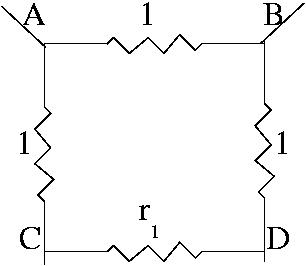
In this diagram the infinite ladder extends downwards and the
network below C and D is effectively the same as the network below
A and B. The total resistance $r_1$ between C and D, for the
infinite network, will be the same as the total resistance $R$
between A and B. So we can think of the resistance between A and B
as a resistance of 1 ohm in parallel with three resistances in
series. Write down the equation and you will get a simple quadratic
equation to solve for $R$.
|
An alternative method is to start with simple cases. When we have an infinite system we often start with $n=1$ and 2, 3, ... and try to find a formula for $n$ and then calculate its limit as ${n\to \infty}$. Very often this method of solving a problem is the best one but not always. In this case the method leads to an infinite continued fraction which can be evaluated to give the required value of the resistance.
You may also like
Hold Still Please
Can you arrange a set of charged particles so that none of them start to move when released from rest?