Skip over navigation


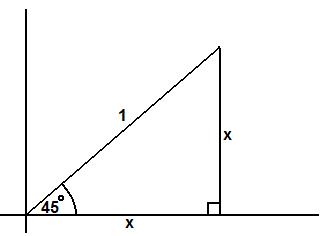
Pythagoras' theorem states that $x^2+x^2=1^2$, i.e. $x^2=\frac{1}{2}$ so $x=\frac{1}{\sqrt{2}}$.
The next part of the question asked for similar ways of calculating the height of the dot after it had turned through $30^{\circ}$ and $60^{\circ}$.
Consider the right angled triangle we obtain after turning through $30^{\circ}$. If we reflect this triangle in the horizontal axis we obtain an equalateral triangle with sides of length $1$ as shown.
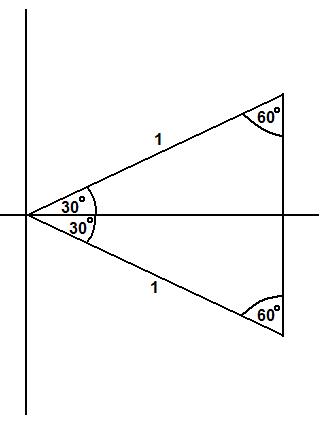
This implies that the height of the dot must be $\frac{1}{2}$. We deduce that at $60^{\circ}$ we end up with the following triangle:
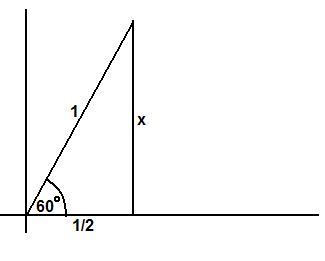
By Pythagoras, the height of the dot must satisfy the equation $x^2+(\frac{1}{2})^2=1^2$ which implies that $x=\sqrt{1-\frac{1}{4}}=\sqrt{\frac{3}{4}}=\frac{\sqrt{3}}{2}$.
By symmetry, now that we know the height of the dot for angles of $30^{\circ}$, $45^{\circ}$ and $60^{\circ}$, we can state the height for angles which are a multiple of $30^{\circ}$, $45^{\circ}$ or $60^{\circ}$. See if you can list these angles and the corresponding heights of the dot.

Where Is the Dot?
Age 14 to 16
Challenge Level 

The first part of this problem was answered correctly by a
number of people. As the film suggests, we can view the dot as a
vertex on a right angled triangle whose hypotenuse has length one.
The angle $45^{\circ}$ is special because at this point the
triangle is equalateral. Let $x$ denote the height of the dot after
it has turned through $45^{\circ}$.
Pythagoras' theorem states that $x^2+x^2=1^2$, i.e. $x^2=\frac{1}{2}$ so $x=\frac{1}{\sqrt{2}}$.
The next part of the question asked for similar ways of calculating the height of the dot after it had turned through $30^{\circ}$ and $60^{\circ}$.
Consider the right angled triangle we obtain after turning through $30^{\circ}$. If we reflect this triangle in the horizontal axis we obtain an equalateral triangle with sides of length $1$ as shown.
This implies that the height of the dot must be $\frac{1}{2}$. We deduce that at $60^{\circ}$ we end up with the following triangle:
By Pythagoras, the height of the dot must satisfy the equation $x^2+(\frac{1}{2})^2=1^2$ which implies that $x=\sqrt{1-\frac{1}{4}}=\sqrt{\frac{3}{4}}=\frac{\sqrt{3}}{2}$.
By symmetry, now that we know the height of the dot for angles of $30^{\circ}$, $45^{\circ}$ and $60^{\circ}$, we can state the height for angles which are a multiple of $30^{\circ}$, $45^{\circ}$ or $60^{\circ}$. See if you can list these angles and the corresponding heights of the dot.
You may also like
Some(?) of the Parts
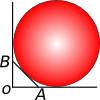
A circle touches the lines OA, OB and AB where OA and OB are perpendicular. Show that the diameter of the circle is equal to the perimeter of the triangle
Ladder and Cube
A 1 metre cube has one face on the ground and one face against a wall. A 4 metre ladder leans against the wall and just touches the cube. How high is the top of the ladder above the ground?
At a Glance
The area of a regular pentagon looks about twice as a big as the pentangle star drawn within it. Is it?