Skip over navigation


This printable worksheet may be useful: Matchless.
Listen to Jenny and Graeme talking together about the problem. [ audio ]
Encounters with simultaneous equations can become over-familiar, routine experiences for students. This type of problem causes a "stop and think" moment, requires some problem-solving ingenuity, and leads into a consideration of redundancy of information. Students might make a start by substituting some arbitrary $x$, $y$ values to get a feel for the problem and to grasp that the five expressions don't generally take the same value.
This is in contrast to expressions that are identities, for example $2 (x+y) - 3(x-y )$ and $5y - x$, where the two expressions take the same value for any $x$, $y$ combination. This idea is worth some discussion.
Questions or prompts:

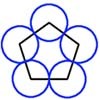
Matchless
Age 14 to 16
Challenge Level 

This printable worksheet may be useful: Matchless.
Listen to Jenny and Graeme talking together about the problem. [ audio ]
Encounters with simultaneous equations can become over-familiar, routine experiences for students. This type of problem causes a "stop and think" moment, requires some problem-solving ingenuity, and leads into a consideration of redundancy of information. Students might make a start by substituting some arbitrary $x$, $y$ values to get a feel for the problem and to grasp that the five expressions don't generally take the same value.
This is in contrast to expressions that are identities, for example $2 (x+y) - 3(x-y )$ and $5y - x$, where the two expressions take the same value for any $x$, $y$ combination. This idea is worth some discussion.
Questions or prompts:
For a start:
$2x + 3y - 20$ equals $ 5x - 2y +38$ ...
Could you find an $x$, $y$ pair that works for two, for three, or for four of the expressions but not for all of them ?
Further ideas:
Make up a similar problem of your own.Or extending that : can you create a similar problem with an "odd one out"? That is, one expression which does not equal the other four, which are equal for some specific $x$, $y$ pair.
The following interesting account was sent in by a class teacher working withYear 8s in Maths Club at St Albans High School for Girls
Becky worked as follows:
$2x + 3y -20 = 4x + 5y -72$
($-2x$ to each side)
$3y -20 = 2x + 5y - 72$
($+72$ to each side)
$3y + 52 = 2x + 5y$
($-3y$ to each side)
$52 = 2x + 2y$
Then, $5x - 2y + 38 = x - 4y + 108$
($-x$ from each side)
$4x - 2y + 38 = -4y + 108$
($+4y$ to each side)
$4x + 2y + 38 = 108$
( $-38$ to each side)
$4x + 2y = 70$
Becky looked at the difference between these two equations and deduced
$2x = 18, so x = 9$
Then using one of her equations, and substituting $x = 9$ she found $y = 17$.
Ele and Sarah reached the same conclusion but started out by looking at
all the possible pairs of expressions. Then they selected the following two
as easiest to work with:
From $2x + 3y - 20 = 4x + 5y - 72$
They deduced $26 = x + y$
From $2x + 3y - 20 = x - 4y + 108$
They deduced $128 = x + 7y$
From these two equations they deduced $6y = 128 - 26$
$6y = 102$
$y= 17$
Then from $x + y = 26$ they found $x = 9$
All three girls were then challenged to decide how much of the information
they needed to use to solve the problem. Their conclusion was only $3$
statements were needed; they could have used $A = B$ and $A = C$ to deduce the answer where $A,B,C$ label different expressions given.
You may also like
Rudolff's Problem
A group of 20 people pay a total of £20 to see an exhibition. The admission price is £3 for men, £2 for women and 50p for children. How many men, women and children are there in the group?
Polycircles
Show that for any triangle it is always possible to construct 3 touching circles with centres at the vertices. Is it possible to construct touching circles centred at the vertices of any polygon?