Skip over navigation
Cambridge University Faculty of Mathematics NRich logo
menu search
  • Teachers expand_more
    • Early years
    • Primary
    • Secondary
    • Post-16
    • Events
    • Professional development
  • Students expand_more
    • Primary
    • Secondary
    • Post-16
  • Parents expand_more
    • Early Years
    • Primary
    • Secondary
    • Post-16
  • Problem-Solving Schools
  • About NRICH expand_more
    • About us
    • Impact stories
    • Support us
    • Our funders
    • Contact us
  • search

Or search by topic

Number and algebra

  • The Number System and Place Value
  • Calculations and Numerical Methods
  • Fractions, Decimals, Percentages, Ratio and Proportion
  • Properties of Numbers
  • Patterns, Sequences and Structure
  • Algebraic expressions, equations and formulae
  • Coordinates, Functions and Graphs

Geometry and measure

  • Angles, Polygons, and Geometrical Proof
  • 3D Geometry, Shape and Space
  • Measuring and calculating with units
  • Transformations and constructions
  • Pythagoras and Trigonometry
  • Vectors and Matrices

Probability and statistics

  • Handling, Processing and Representing Data
  • Probability

Working mathematically

  • Thinking mathematically
  • Developing positive attitudes
  • Cross-curricular contexts

Advanced mathematics

  • Decision Mathematics and Combinatorics
  • Advanced Probability and Statistics
  • Mechanics
  • Calculus

For younger learners

  • Early Years Foundation Stage

New House

Age 7 to 11
Challenge Level Yellow star
  • Problem
  • Student Solutions
  • Teachers' Resources

New House


Well it's nice to move into a new house sometimes. For some people it's great fun to design and make a new house. I've been thinking of an idea where the house is built out of blocks which are the rooms. I don't know whether you've seen some builders' sheds set up this way on big building sites when the sheds or offices are linked together with big steel girders? Well I'm thinking that it could be good fun to design houses with that sort of idea in mind.

Well we have to buy some land first and suppose that we buy four big squares.


I reckon that a good house may have about 7 rooms. So let's use some interlocking cubes to stand for the rooms and arrange each of them so that they are connected and NOT spilling over the 4 square base size.

Perhaps like this - I've used 7 differently coloured cubes so as to follow things more easily:-

new1

There are of course lots of different designs.
Take some interlocking cubes such as "multilink" and have a go at making some now!

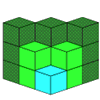
Make sure that they stand up! You may be able to do one like:-
new2

But according to what your interlocking cubes are like you may or may not be able to do that one.

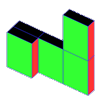
But maybe you could do:-

new3

The whole idea of this investigation is to try to find all the different designs that you can. You can decide for yourselves whether shapes that are just turned around $90^\circ$ are the same or different. The same goes for the designs that are reflections of another design.

YOU DECIDE.

It would probably be good to see if you can find some kind of system/method/pattern for doing these and try to write down those ideas that you have.

Of course we have to ask "I wonder what would happen if ...":

a/ the base was 5, 6, 7, 8, or 9 squares?

b/ the base was bigger, would it matter what shape the squares are arranged in?

c/ you had 8 or 9 or 10 rooms?

d/ etc.

Here is some dotty isometric paper which might help for drawing the cubes.

If you're not sure about drawing them on these dots it really does not matter. But if you fancy that idea and you have not used these triangular arranged dots before then this is what you do:

1/ Take 7 dots arranged like a hexagon with one dot in the middle:-

 7 new dots
 

2/ Draw a capital Y by using every other dot:-


3/ Draw in the six sides of the hexagon:-


Good luck

Remember to send in your results.


Why do this problem?

This activity can be a fun way of introducing pupils to the idea of considering a system/method/pattern when tackling some investigations.

Possible approach

If you are happy with a computer presentation package then a captivating way of introducing the problem would be for them to see a house gradually taking place.
I would suggest that recording is not made an issue here as it can be rather hard, although I have found that 9-10 year olds can usually invent quite good ways of recording each design. A simple example I've come across has been:-
recording

and then various ways have been found for tackling the overhanging, balcony rooms.

Key questions

Tell me about the ways that you are finding more and more house shapes.

Possible extension

Using extension activities such as asking how much paint would be used to paint the outside of the designs is a good activity to link with surface area work. If children are challenged to find designs which use less paint and try to explain why that is so, really good-quality maths talk happens.

Possible support

As mentioned in the problem some isometric paper can be a help for those who want to record in that way, however using a digital camera can make it easier for the pupils.


You may also like

Polydron

This activity investigates how you might make squares and pentominoes from Polydron.

Multilink Cubes

If you had 36 cubes, what different cuboids could you make?

Cereal Packets

How can you put five cereal packets together to make different shapes if you must put them face-to-face?

  • Tech help
  • Accessibility Statement
  • Sign up to our newsletter
  • Twitter X logo

The NRICH Project aims to enrich the mathematical experiences of all learners. To support this aim, members of the NRICH team work in a wide range of capacities, including providing professional development for teachers wishing to embed rich mathematical tasks into everyday classroom practice.

NRICH is part of the family of activities in the Millennium Mathematics Project.

University of Cambridge logo NRICH logo