Skip over navigation



Out of Line
Age 11 to 14
ShortChallenge Level 

The starred square contains a B.
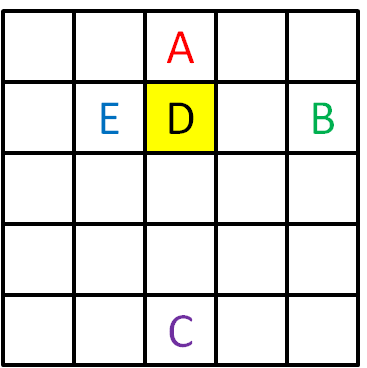 The square marked in yellow in the diagram on the right must be a D, since it is in the same row as B and E, and the same column as A and C.
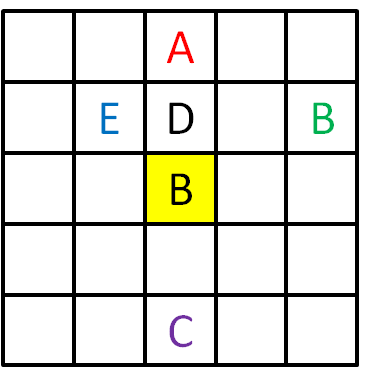 The square marked in yellow must contain a B, as it is in the same column as A, D and B, and is in the same diagonal as E.
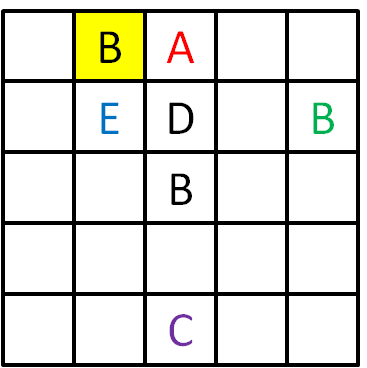 Consider the top row. This must have one of each of the letters in it, so in particular it must contain a B. The right-hand-most square is in the same column as the green B. The square to the left of this is in the same diagonal as this green B. The left-hand-most square is
in the same diagonal as the black B. This means only the yellow square can contain the B.
Consider the top row. This must have one of each of the letters in it, so in particular it must contain a B. The right-hand-most square is in the same column as the green B. The square to the left of this is in the same diagonal as this green B. The left-hand-most square is
in the same diagonal as the black B. This means only the yellow square can contain the B.
Alternatively, you could use similar logic looking at the second column.
The square marked in yellow in the diagram on the right must be a D, since it is in the same row as B and E, and the same column as A and C. The square marked in yellow must contain a B, as it is in the same column as A, D and B, and is in the same diagonal as E. Consider the top row. This must have one of each of the letters in it, so in particular it must contain a B. The right-hand-most square is in the same column as the green B. The square to the left of this is in the same diagonal as this green B. The left-hand-most square is
in the same diagonal as the black B. This means only the yellow square can contain the B.Alternatively, you could use similar logic looking at the second column.
This problem is taken from the UKMT Mathematical Challenges.
You can find more short problems, arranged by curriculum topic, in our short problems collection.
You may also like
Adding All Nine
Make a set of numbers that use all the digits from 1 to 9, once and once only. Add them up. The result is divisible by 9. Add each of the digits in the new number. What is their sum? Now try some other possibilities for yourself!
Summing Consecutive Numbers
15 = 7 + 8 and 10 = 1 + 2 + 3 + 4. Can you say which numbers can be expressed as the sum of two or more consecutive integers?