Skip over navigation



Integration Matcher
Age 16 to 18
Challenge Level 

Why do this problem?
This problem offers students insights into differentiation, integration and the relationships between the two. It would be well suited to use as an introduction or summary to differentiation or integration. By exploring possible relationships between the pairs of functions, students can begin to develop intuition about differentiation and integration as inverse operations. Presenting the
charts as cards to sort provokes students' natural curiosity as they look for relationships between them. The charts could be used as a problem involving fitting curves to equations, or to practise numerical integration.
Possible approach
This printable version of the charts may be useful: Integration MatcherGive the graphs to the class and allow them some time to think about them. One way of doing this would be to cut out the twelve graphs and invite students to sort them into groups in whatever way they like, and then discuss the groupings they have chosen and their reasons.
Now introduce the problem - explain that the functions can be paired up. For classes who have not yet met integration: "These graphs come in pairs. For each function $f(x)$ there is a graph of the function $A(x)$ where $A(x)$ is the area under the curve $y=f(t)$ between $t=0$ and $t=x$. Can you match each graph of a function $f$ with its corresponding graph of the area function $A$?"
Students could work in pairs to match up the graphs. It is important that they give evidence for why they believe that each pair goes together; their reasoning could be discussed in small groups or as a whole class. Students who have met the idea of integration as anti-differentiation could use this to check their pairings by looking for turning points mapping to a zero on the derivative graph.
Now introduce the problem - explain that the functions can be paired up. For classes who have not yet met integration: "These graphs come in pairs. For each function $f(x)$ there is a graph of the function $A(x)$ where $A(x)$ is the area under the curve $y=f(t)$ between $t=0$ and $t=x$. Can you match each graph of a function $f$ with its corresponding graph of the area function $A$?"
Students could work in pairs to match up the graphs. It is important that they give evidence for why they believe that each pair goes together; their reasoning could be discussed in small groups or as a whole class. Students who have met the idea of integration as anti-differentiation could use this to check their pairings by looking for turning points mapping to a zero on the derivative graph.
Key questions
What are the key features of each graph?
What does it mean if an area function is positive? Negative? Zero?
If the area function has a turning point, what is happening to the original function at that point?
If the area function has a turning point, what is happening to the original function at that point?
Possible extension
The extension in the problem challenges students to suggest algebraic forms for each function. Some of the functions are easier to work out than others!
Possible support
Encourage students to start with the 'easiest' curves. They could make sketches of what the area function would look like for each curve by estimating the area, perhaps using trapezia to make the link to numerical methods of integration.
You may also like
Generally Geometric
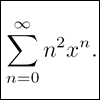
Generalise the sum of a GP by using derivatives to make the coefficients into powers of the natural numbers.
Bend
What is the longest stick that can be carried horizontally along a narrow corridor and around a right-angled bend?
Exponential Trend
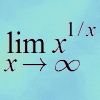
Find all the turning points of y=x^{1/x} for x>0 and decide whether each is a maximum or minimum. Give a sketch of the graph.