Skip over navigation
Cambridge University Faculty of Mathematics NRich logo
menu search
  • Teachers expand_more
    • Early years
    • Primary
    • Secondary
    • Post-16
    • Events
    • Professional development
  • Students expand_more
    • Primary
    • Secondary
    • Post-16
  • Parents expand_more
    • Early Years
    • Primary
    • Secondary
    • Post-16
  • Problem-Solving Schools
  • About NRICH expand_more
    • About us
    • Impact stories
    • Support us
    • Our funders
    • Contact us
  • search

Or search by topic

Number and algebra

  • The Number System and Place Value
  • Calculations and Numerical Methods
  • Fractions, Decimals, Percentages, Ratio and Proportion
  • Properties of Numbers
  • Patterns, Sequences and Structure
  • Algebraic expressions, equations and formulae
  • Coordinates, Functions and Graphs

Geometry and measure

  • Angles, Polygons, and Geometrical Proof
  • 3D Geometry, Shape and Space
  • Measuring and calculating with units
  • Transformations and constructions
  • Pythagoras and Trigonometry
  • Vectors and Matrices

Probability and statistics

  • Handling, Processing and Representing Data
  • Probability

Working mathematically

  • Thinking mathematically
  • Developing positive attitudes
  • Cross-curricular contexts

Advanced mathematics

  • Decision Mathematics and Combinatorics
  • Advanced Probability and Statistics
  • Mechanics
  • Calculus

For younger learners

  • Early Years Foundation Stage

Curve Match

Age 16 to 18
Challenge Level Yellow star
  • Problem
  • Getting Started
  • Student Solutions
  • Teachers' Resources


Why do this problem?

This challenge could be used as a lesson starter to check students' ability to match curves with their equations. Finding other functions which do not intersect with the existing curves except at the endpoints can help students to develop a stronger sense of how to manipulate functions and the corresponding effect on the graph.


Possible approach


This problem lends itself to discussion as a class or in small groups. Give students a short time to consider how to identify which is the $x$ and which is the $y$ axis, then share reasoning.
Are there any of the curves they can identify straight away? The curves could be matched using some numerical work to identify key points on the graphs. Alternatively, students could consider how they could sketch the less familiar curves by transforming the functions which are more recognisable.


Considering the relationship between the functions which were chosen for the problem may lead to insight into how to create more curves with the same endpoints which do not intersect at any other point in the region. Students could use graph-plotting software to sketch these graphs and explain how they know there are no other points of intersection.


Key questions


Are there any curves which can be identified straight away?
Which curves have similar shapes to each other? How can they be distinguished?
Is there a relationship between any of the curves?

Possible extension

Come up with ways of generating curves between any pair on the grid, and prove that there are no intersections except at the end points.

Possible support

Work numerically to plot a few key points for each given function, and use these to identify the $x$ and $y$ axes and each curve.


You may also like
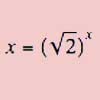
How Many Solutions?

Find all the solutions to the this equation.

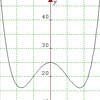
Quartics

Investigate the graphs of y = [1 + (x - t)^2][1 + (x + t^)2] as the parameter t varies.

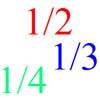
Power Up

Show without recourse to any calculating aid that 7^{1/2} + 7^{1/3} + 7^{1/4} < 7 and 4^{1/2} + 4^{1/3} + 4^{1/4} > 4 . Sketch the graph of f(x) = x^{1/2} + x^{1/3} + x^{1/4} -x

  • Tech help
  • Accessibility Statement
  • Sign up to our newsletter
  • Twitter X logo

The NRICH Project aims to enrich the mathematical experiences of all learners. To support this aim, members of the NRICH team work in a wide range of capacities, including providing professional development for teachers wishing to embed rich mathematical tasks into everyday classroom practice.

NRICH is part of the family of activities in the Millennium Mathematics Project.

University of Cambridge logo NRICH logo